
Google to produce 3 million TPUs using Intel packaging
TSMC 'production bottleneck' opens door for alternatives
Other foundries seen as beneficiaries
Samsung foundry may turn profitable this year
Samsung foundry chief: 'Whether it takes 10 or 20 years, you still have to dream'
![Google unveiled its eighth-generation AI chips, the TPU 8t and TPU 8i, at the Google Cloud Next event held at the Mandalay Bay Convention Center in Las Vegas on April 22 (local time). Pictured is the inference-optimized TPU 8i, previewed at a pre-event the day before. [Yonhap]](https://wimg.heraldcorp.com/news/cms/2026/06/10/rcv.YNA.20260422.PYH2026042217560001300_P1.jpg)
Google is considering entrusting a portion of its in-house AI chip production — its TPU, or Tensor Processing Unit — to Intel, sources say. Google has long relied on Taiwan's TSMC for foundry production, but as TSMC's capacity struggles to keep pace with surging AI chip demand, Intel and Samsung Electronics are seen as potential beneficiaries.
According to The Information, a US technology publication, Google decided to award Intel a contract to produce more than 3 million TPUs for use in 2028, after testing Intel's packaging technology for several months. The report cited anonymous sources.
Google is expected to produce 6 million TPUs in 2027 and 2028 combined, with roughly half of that volume going to Intel. TPUs are co-designed by Google and Broadcom, and TSMC has handled production.
Nvidia, which currently entrusts all of its AI chip production to TSMC, is also reportedly testing Intel's technology for a processor that links four GPUs into a single unit.
However, it remains unclear whether Google and Nvidia plan to use Intel's foundry process itself or focus solely on its chip packaging services.
The publication said large customers such as Google are seeking alternative production sources as TSMC can no longer absorb all of the demand.
According to market research firm Counterpoint Research, TSMC effectively dominates the global foundry market. The company held a 73 percent share in the first quarter, far ahead of second-place Samsung Electronics at 7 percent.
Yet demand for AI chips from big tech companies including Nvidia, Google, Amazon and Microsoft has surged so sharply that TSMC's production capacity has become what some describe as a "bottleneck" for AI development.
TSMC Chairman Wei Che-chia said at a recent shareholders' meeting that customer demand had exceeded what the company could handle. "There is a limit to what we can manage," he said, adding that the company was doing its best to avoid creating a bottleneck.
With TSMC now running at full capacity, chip designers are actively looking for alternatives.
Intel has emerged as one beneficiary. Industry observers say Google's TPU order carries significance beyond the volume itself, with the win from such a major customer expected to help attract additional clients.
Intel recently secured a portion of Apple's next-generation processor production with US government support, reportedly using its most advanced 18A (1.8-nanometer-class) process.
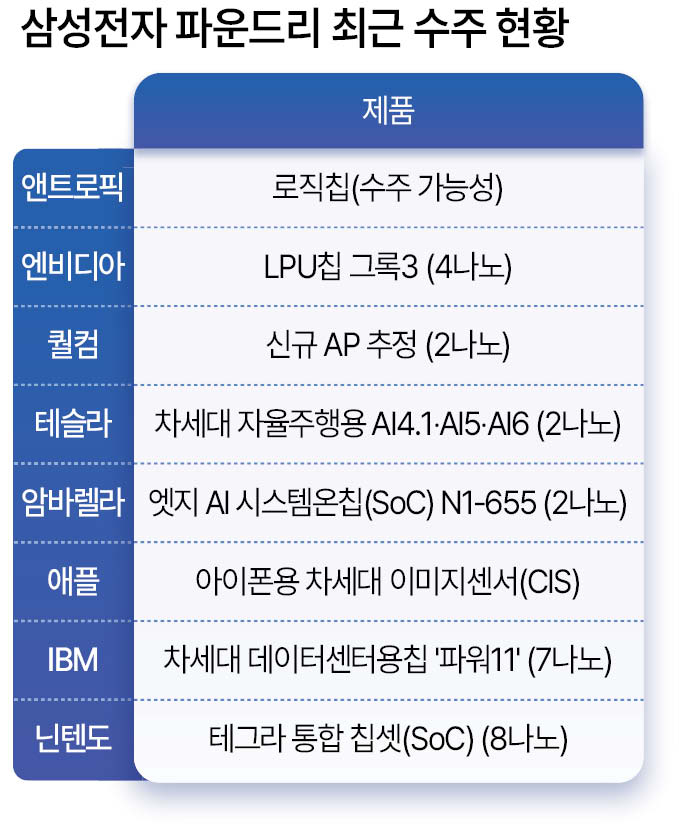
Samsung Electronics' foundry division is also expected to benefit from TSMC's capacity constraints.
Samsung Electronics CEO and semiconductor division chief Jun Young-hyun met with Nvidia CEO Jensen Huang on June 8 and said afterward that the two sides had discussed "long-term cooperation in foundry and other areas, not just memory chips."
He added that the companies are collaborating on autonomous driving chips at the 4-nanometer and 8-nanometer nodes, as well as on Nvidia's Groq accelerator chip, and that they are also discussing cooperation on the next generation of products.
Samsung's foundry division is internally projecting that it could return to profitability as early as the third quarter of this year, according to sources.
Starting in the second half of this year, Samsung foundry plans to begin mass production of AI5 and AI6 chips at its Taylor, Texas factory using its most advanced 2-nanometer process. The division is also seen as a strong candidate to win a logic chip order from US AI company Anthropic.
Han Jin-man, president of Samsung Electronics' foundry division, spoke to reporters on June 8 after attending Nvidia's Korea AI Ecosystem event. Asked about TSMC Chairman Wei's recent remark — widely understood as a veiled reference to Samsung — that "competitors are essentially just dreaming," Han replied with confidence: "Whether it takes 10 years or 20 years, you still have to dream."
go@heraldcorp.com




