Ministry of Land warns overlapping authority could delay projects
Zone-designation power was devolved to local governments in 2003
Experts warn of market confusion as central government expands housing powers
![A residential neighborhood of low-rise villa-style buildings in Seoul. This photo is not directly related to the article. [Yonhap]](https://wimg.heraldcorp.com/news/cms/2026/06/10/rcv.YNA.20250924.PYH2025092407710001300_P1.jpg)
A bill under National Assembly review would transfer the power to designate urban redevelopment zones from provincial and metropolitan governors to the minister of land, infrastructure and transport — and the very ministry it would empower has filed a de facto objection. The Ministry of Land, Infrastructure and Transport warned that overlapping designation authority could create administrative confusion and slow housing supply projects. Experts are raising alarms about the political use of housing policy, noting that the central government is seeking to claw back zone-designation powers after its earlier move to take control of land transaction permit zones.
Bill would give minister authority to designate and revoke redevelopment zones
According to the National Assembly's Land, Infrastructure and Transport Committee on Wednesday, Democratic Party of Korea lawmaker Ahn Tae-jun introduced a bill in January to amend the Act on the Improvement of Urban Areas and Residential Environments. The bill would allow the minister of land, infrastructure and transport to directly designate or revoke redevelopment zones in areas where the designation process has stalled. It would also permit zone reviews to go before the Central Urban Planning Committee rather than a local urban planning committee.
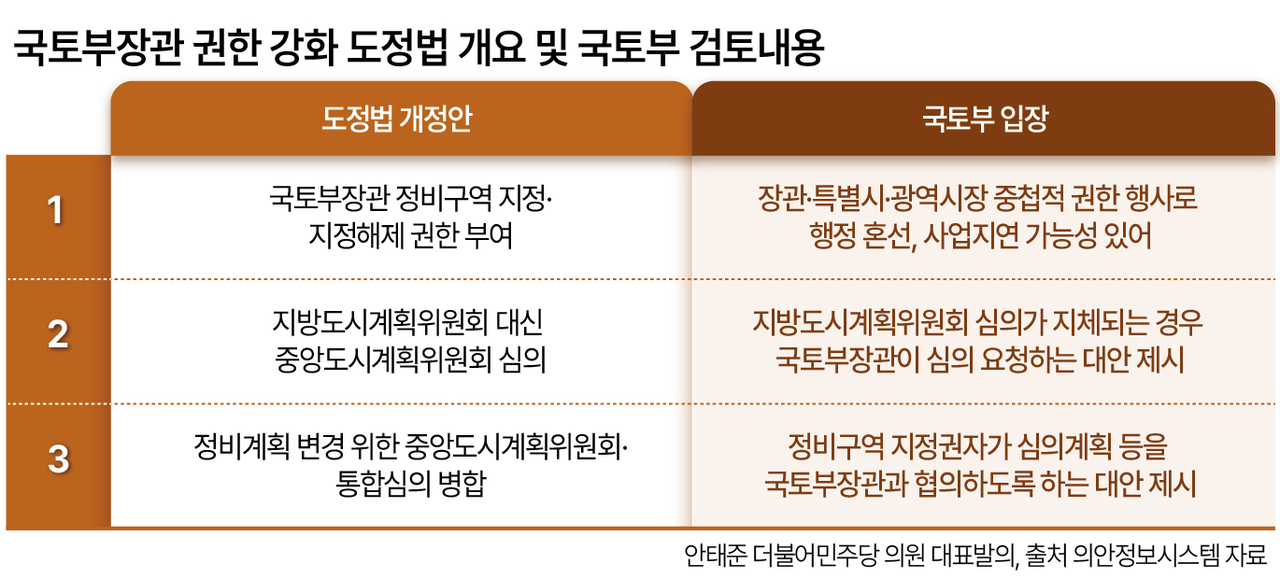
The amendment was referred to the Land, Infrastructure and Transport Committee in April and has undergone one round of deliberation. Despite expressing sympathy with the bill's stated aim of boosting housing supply, the Ministry of Land submitted a "needs careful review" opinion — in effect registering its opposition.
The ministry concluded that expanding permit authority in this way could actually slow redevelopment projects rather than accelerate them. "If the minister of land and the mayors of special and metropolitan cities exercise overlapping zone-designation authority, administrative confusion could cause project delays," the ministry said.
Officials also raised concerns that the bill fails to account for the ongoing nature of redevelopment project management — including zone boundary changes and project implementation approvals that continue long after initial designation. "Given the permit structure in which the current zone-designation authority handles follow-up management after designation, overlapping authority at that stage could also delay projects," the ministry said.
Zone-designation power was transferred to local governments during the Roh Moo-hyun administration
As an alternative, the ministry proposed a mechanism under which district mayors and other local officials could report to the minister when a local urban planning committee delays its review, allowing the minister to formally request that the zone-designation authority proceed with the review. The proposal amounts to a compromise — giving the minister a tool to push stalled projects forward without directly taking over the permit authority.
A ministry official said in a phone interview that "there is a shared understanding within the government that while the central government can step in to mediate in deadlocked areas, directly handling the permits itself would not be easy."
Experts share those concerns, warning that transferring redevelopment zone-designation power to the central government could cause significant disruption in the housing market.
The authority to designate redevelopment zones was fully transferred to metropolitan and provincial governors in 2003 under the "decentralization roadmap" of the Roh Moo-hyun administration. The rationale was that local governments, with their deeper knowledge of their own communities, were better positioned to designate and manage redevelopment zones — given the high-stakes nature of such projects, which involve residents' property rights and the potential to fuel speculation.
Lee Ji-hyun, head of the urban redevelopment division at the Korea Housing Industry Research Institute, said that in cities with populations of 500,000 or more, local governments draw up residential environment improvement plans. "The reason local governments do this is to manage the overall volume of redevelopment and demolition," she said. "If the Ministry of Land's plans start being inserted into that process, it will create confusion."
Ruling camp moves to shift more local authority to central government
![Minister of Land, Infrastructure and Transport Kim Yun-deok announces a real estate housing supply expansion plan at the Government Seoul Complex on Sept. 7 last year. [Yonhap]](https://wimg.heraldcorp.com/news/cms/2026/06/10/rcv.YNA.20250907.PYH2025090707110001301_P1.jpg)
Even beyond this particular bill, the ruling camp has been steadily pursuing policies that shift housing authority away from local governments and toward the central government.
A prime example is the Special Act on Mixed-Use Development of Aging Public Buildings, announced as part of the Sept. 7 real estate supply package, which grants the land minister direct development authority. Under the act, the minister can designate idle public land held by the state, local governments or public institutions as mixed-use development zones and select project operators — all without requiring agreement from local governments or relevant agencies. If 30 days pass without a resolution, consultations are deemed complete and the process moves forward.
A bill amending the Act on Real Estate Transaction Reporting — which would transfer to the land minister the authority that provincial and metropolitan governors currently hold to designate land transaction permit zones within a single local government's jurisdiction — is also awaiting a full plenary vote. The government has already used an existing provision allowing the minister to designate permit zones spanning two or more cities and provinces to bundle all of Seoul and 12 areas of Gyeonggi Province under a single designation. The government and ruling party now want to go further, amending the law so the minister can designate individual Seoul districts as land transaction permit zones without that condition.
A professor who requested anonymity said the original purpose of land transaction permit zones was to curb speculative capital inflows, serving as a tool for local government heads to carefully monitor their communities. "If this kind of authority is used for political ends, it could ultimately throw the housing market into chaos — including a triple surge in jeonse, monthly rent and sale prices," the professor said.
![동탄 ‘생애 첫집마련’ 올 들어 165% 급증…정부 “토허구역 지정 검토 안 해” [부동산360]](https://wimg.heraldcorp.com/news/cms/2026/06/10/news-p.v1.20251022.d1f2f7fba3494b0883052cff2f77f9b0_T1.jpg)
hss@heraldcorp.com