
Employed Koreans aged 60 and older reach 6.83 million, overtaking those in their 50s for the first time; aging population, job program expansion and high elderly poverty rate cited as drivers
![Middle-aged and older job seekers consult with staff about senior employment programs at the 2024 Busan Job Festival. About 80 percent of the public supports raising the mandatory retirement age from 60 to 65. [Newsis]](https://wimg.heraldcorp.com/news/cms/2026/06/10/news-p.v1.20250322.98b896e273fa45fbabb434a467a3c761_P1.jpg)
The number of employed Koreans aged 70 and older surpassed 2 million last year for the first time, driven by an aging population and the expansion of senior job programs — though analysts also point to South Korea's elderly poverty rate, the highest in the OECD, as a key factor keeping older workers in the labor market.
Data from the Ministry of Statistics' national statistics portal KOSIS released Wednesday showed that workers aged 70 and older totaled 2.162 million last year, up 9.2 percent from 1.98 million the year before. It was the first time the figure had crossed the 2 million mark since related statistics began being compiled in 2018.
The number of employed workers in that age group rose consistently from 1.219 million in 2018, breaking the 1.5 million threshold in 2021 at 1.566 million. Annual growth of roughly 7 to 10 percent continued in subsequent years, pushing the figure past 2 million within four years. The count has grown approximately 1.8 times compared with 2018, over six years.
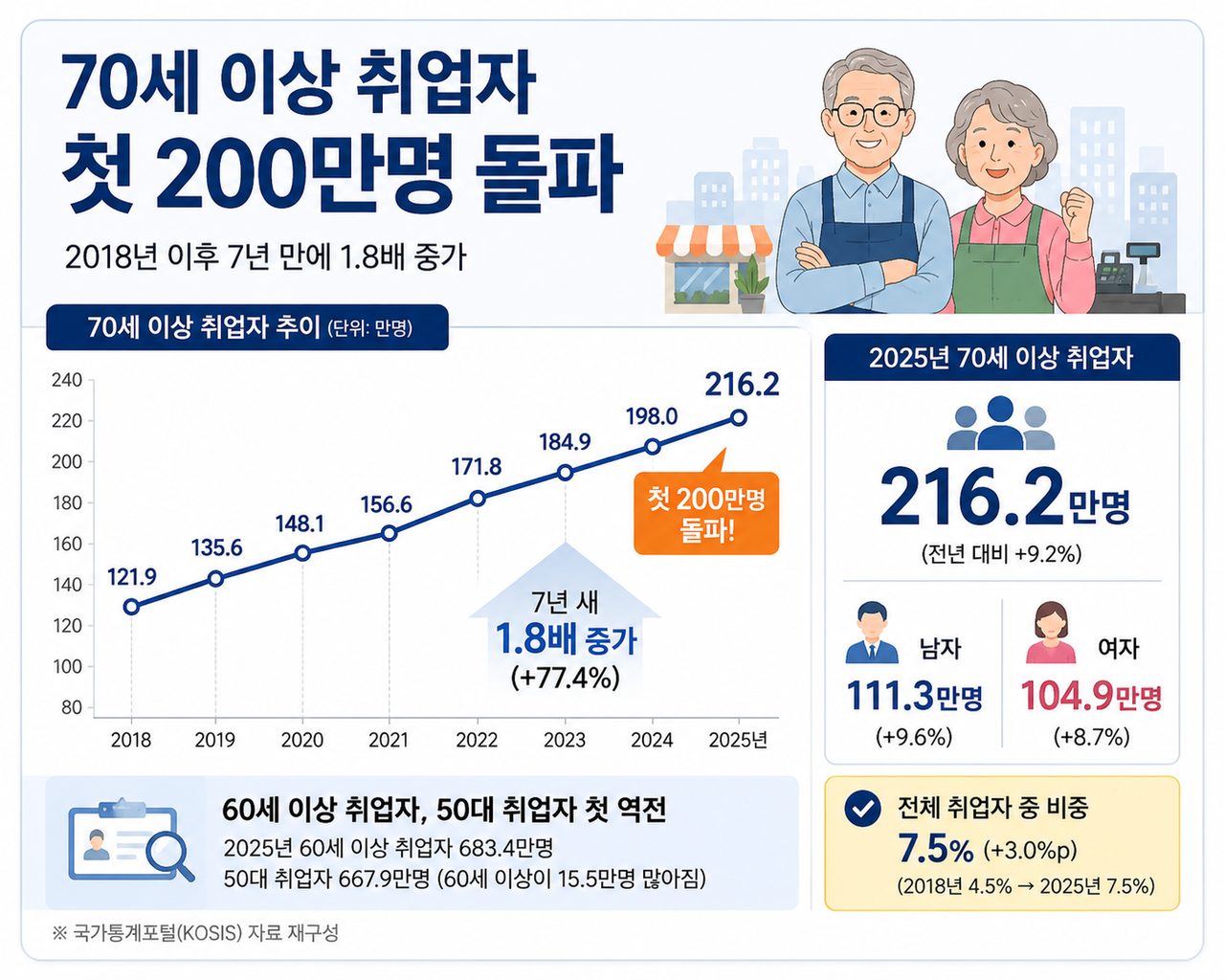
The share of workers aged 70 and older within the total employed population has also grown, rising 3.0 percentage points from 4.5 percent in 2018 to 7.5 percent last year.
By gender, male workers in the age group numbered 1.113 million, up 9.6 percent from the previous year, while female workers reached 1.049 million, a gain of 8.7 percent. Men had crossed the 1 million mark for the first time in 2024 and continued to climb; women surpassed that threshold for the first time last year.
The trend extends across the broader older population. Workers aged 60 and older totaled 6.834 million last year, up 5.3 percent from a year earlier, while those in their 50s fell 0.4 percent to 6.679 million. That left the 60-and-older group ahead by 155,000 — the first time workers in that age bracket had outnumbered those in their 50s since age-based employment statistics were first compiled in 1963.
Experts attribute the rise primarily to demographic shifts from an aging population and the expansion of government-backed senior job programs. The population aged 70 and older grew by roughly 1.8 million over the same period, from 5.025 million in 2018 to 6.822 million last year.
However, analysts caution that older workers remaining in the labor market is not entirely a positive development, as many elderly Koreans continue working past retirement simply to cover living expenses.
According to "Social Trends in Korea 2025," published by the Statistics Research Institute, the income poverty rate among Koreans aged 66 and older stood at 39.7 percent — the highest among OECD member countries and more than double the OECD average of 14.8 percent.
"Today's 60-somethings are healthier than previous generations and can sustain economic activity longer, but there are still many older Koreans who simply cannot afford to stop working because of elderly poverty that remains the worst in the OECD," said Jeong Sun-dool, a professor at Ewha Womans University. "There is a need to strengthen support for retirement preparation and to expand the basic pension and quality senior employment programs."
fact0514@heraldcorp.com




