Average deposit for new contracts this year reaches 656.33 million won (about $424,000), up 18%; supply plunges 34% as tax reform and tighter lending rules threaten further increases
![A real estate agency in central Seoul displays property listings with price tags. [Herald DB]](https://wimg.heraldcorp.com/news/cms/2026/06/09/news-p.v1.20260522.c1e0f9bea53043c7962fefcf67e1ec6d_P1.jpg)
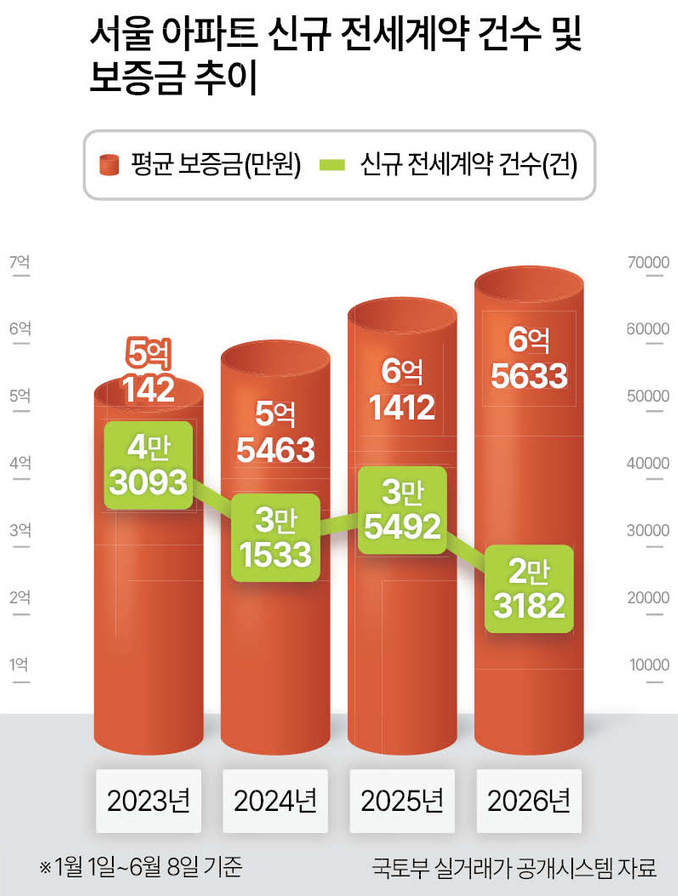
Jeonse deposits on newly signed Seoul apartment contracts this year have risen by roughly 100 million won compared with two years ago, driven by a sharp drop in available supply. Experts warn that if the government moves ahead with plans to cut tax benefits for registered landlords in a tax reform package due in July — and tightens regulations on jeonse loans — the resulting surge in jeonse prices could turn a creeping housing affordability problem into a full-blown crisis.
The average deposit on new jeonse contracts signed in Seoul from Jan. 1 through Sunday, based on data from the Ministry of Land, Infrastructure and Transport's actual transaction price disclosure system, stood at 656.33 million won. That is 101.7 million won, or 18.3 percent, higher than the same period two years ago, when the average was 554.63 million won. Tenants whose two-year contracts are expiring now need to find more than 100 million won in additional funds to secure a new home.
The price increase appears to stem from a contraction in supply. The number of new jeonse contracts signed so far this year came to 23,182 — a 34 percent plunge from 35,492 in the same period last year and 26 percent below the 31,533 recorded two years ago.
On the ground, the shortage feels even more acute. The 84-square-meter unit type at Godeok Graceium in Godeok-dong, Gangdong-gu carried a jeonse market price of around 850 million won as recently as May 2024, but a new contract was signed at 1.1 billion won in January this year — a jump of 250 million won in two years.
At Jamsil Els in Jamsil-dong, Songpa-gu, the same unit type went for 1.25 billion won on a new contract in May 2024 but reached 1.4 billion won by May this year, up 150 million won in two years. At Lotte Woosung in Junggye-dong, Nowon-gu, a 115-square-meter unit that could be leased for 800 million won as late as May 2024 has been trading at 950 million won since January this year.
Much of the price pressure traces back to the government's Oct. 15 real estate measures, which designated all of Seoul as a land transaction permit zone and imposed an owner-occupancy requirement. By banning the purchase of homes with existing tenants in place, the policy pushed buyers to move in themselves, rapidly draining the pool of jeonse listings.
The government has opened an exit for multi-homeowners and non-resident single-homeowners to sell tenanted properties through the end of this year, but because buyers must occupy the units once existing lease contracts expire, demand for rental housing is only set to grow.
At a press conference Monday marking his first year in office, President Lee Jae-myung acknowledged the supply squeeze. "It is only natural that jeonse supply has fallen, because homes that used to be rented out have been sold," he said, adding that "demand has also fallen by the same amount, since people without homes bought those properties to live in themselves."
He also said that while jeonse prices have "risen noticeably in terms of what people feel," the statistical picture was "not a massive surge — it is a normalization process." According to Korea Real Estate Board data, the cumulative jeonse price increase in Seoul from Jan. 1 through June 1 this year was 3.77 percent — not a large figure in absolute terms. The concern, however, is the pace: that 3.77 percent gain is roughly six times the 0.65 percent recorded over the same period last year.
Despite the government's relatively sanguine assessment, industry insiders say the shortage of rental homes is worsening faster than officials acknowledge, and that the policy direction ahead points toward even fewer jeonse listings.
Markets expect the government's July tax reform package to impose the same heavy tax burden on registered rental properties whose mandatory lease periods have expired as on ordinary multi-homeowners, effectively stripping away existing tax benefits. If that happens, analysts say, landlords who lose those benefits may either evict tenants and put properties up for sale or pass the higher tax burden on to tenants through rent increases.
The outlook could darken further if financial regulators ban extensions of jeonse loans for single-homeowners and bring jeonse loans under the debt service ratio (DSR) framework — moves that would add another layer of disruption to an already strained market.
"Supply needs to be expanded across both apartment and non-apartment housing to ease upward pressure on jeonse prices," said Yoon Su-min, a real estate specialist at NH NongHyup Bank's All100 Advisory Center. "For now, the market is not yet feeling a meaningful supply effect, so instability in the lease market is likely to persist for some time."
Kim In-man, director of Kim In-man Real Estate Economic Research Institute, drew a contrast with the previous administration. "Under the Moon Jae-in government, the problem was a price surge triggered by the passage of the '2+2' lease law; the current jeonse crunch is a supply problem — there simply are no listings," he said. "The housing stability of ordinary people is being shaken, and treating that as a 'normalization' process risks a serious misreading of the situation."
hss@heraldcorp.com