
IP Office publishes guide on proper patent filing in the AI era, outlining good-faith obligations for applicants
Amid a surge in AI-assisted patent applications, South Korea's intellectual property authority has issued guidelines aimed at curbing indiscriminate filings generated by AI and promoting responsible patent practices.
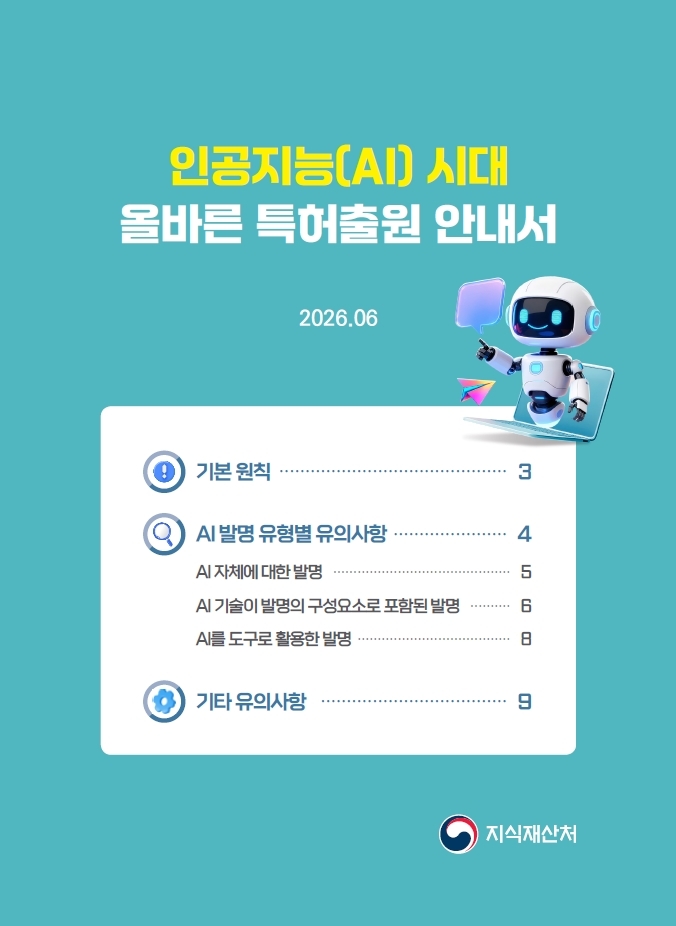
The Korea Intellectual Property Office (KIPO), led by Commissioner Kim Yong-seon, announced Monday it would distribute a new publication titled "Guide to Proper Patent Filing in the AI Era," outlining the due-diligence obligations applicants must meet when filing patents for AI-assisted inventions and the requirements needed to obtain a patent.
The guide covers four main areas: the requirement that a human make a substantive creative contribution to an invention for it to qualify for a patent; legal liability for submitting AI-generated test results as if they were real experimental data; patent requirements that vary by type of AI invention; and security precautions to prevent invention details from leaking when using AI tools.
Human contribution required — AI use alone not enough for patent registration
Under patent law, AI cannot hold a patent; only the person who made the invention, or their successor, may obtain one. To be recognized as a legitimate inventor, a person must have made a substantive contribution to the creative process of the invention. Simply entering general instructions into an AI system and filing the output as-is does not qualify for a patent, and any patent granted on that basis would be invalidated.
During examination, if an examiner has reason to doubt whether a legitimate inventor exists, the examiner may issue a notice of grounds for rejection and request supporting documents — such as a research and development notebook or an inventor confirmation form — to verify that a human contributed to the invention.
Legal liability for submitting AI-generated test results as genuine experimental data
Because AI hallucinations can produce technical content and claimed effects that do not exist in reality, applicants must not take AI-generated content at face value. Applicants and their representatives are required to thoroughly verify the accuracy of the content and the feasibility of the invention when drafting patent documents such as specifications and written opinions.
Extra caution is needed when filing patents for pharmaceuticals or advanced materials developed with AI assistance. Filing a patent application without experimentally verifying candidate substances or efficacy proposed by AI will result in rejection on feasibility grounds, and any patent already granted will be invalidated. If an applicant fraudulently obtains a patent by presenting AI-generated experimental results — without verification — as their own, they may face additional criminal liability for fraudulent conduct.
Patent requirements by type of AI invention
AI inventions fall into three broad categories, each with specific patent requirements to watch. For inventions of AI itself, the invention must meet the eligibility requirement that the AI performs information processing in combination with hardware such as memory chips. When AI is incorporated as a component of an invention, the invention must satisfy the inventive step requirement by demonstrating a distinctive technical feature that produces a superior effect over prior art. For inventions that use AI as a tool, applicants must not simply transcribe the effects proposed by AI; they must fully review feasibility and draft the specification in accordance with the disclosure requirements.
For example, if AI is incorporated as a component of an invention — such as "a method of sorting fruit using AI" — the application will not be patentable if it merely replaces work previously done by humans with AI, without any specific technical features of the AI itself.
Security risks: invention details may leak when using AI
Data entered while using AI tools may be incorporated into the training of external AI models and thereby become accessible to others, so applicants must take particular care with trade secrets and core technical information. One precaution is to configure user settings before using AI to ensure that input data will not be used to train external AI models.
KIPO Deputy Commissioner Jeong Yeon-u said the guide was prepared "to proactively set out the due-diligence obligations that applicants must observe as AI use becomes more widespread." He added that international harmonization of examination standards for AI-assisted inventions is critical, and that KIPO intends to take a leading role in discussions at the upcoming IP5 heads-of-IP-offices meeting "to build a patent regime suited to the AI era."
kwonhl@heraldcorp.com




