Estate of 7 billion won faces projected inheritance tax bill of 1.24 billion won (about $900,000)
Using dividends to pay the tax compounds the income-tax burden
Installment payments and payment-in-kind have clear limits — securing cash is the key challenge
Solutions for paying inheritance tax while preserving management control
Corporate-name life insurance to build a cash reserve in advance
'Inheritance capital reduction' offers tax savings without triggering capital gains

CEO Kim (67), who runs an unlisted company, spent days in a somber mood after hearing that a longtime business partner — CEO Han — had died suddenly. The two had worked together for more than 20 years. Han's family was now caught between a staggering inheritance tax bill worth billions of won and a looming battle over management control. "This is not someone else's problem," Kim could not stop thinking. He too had built his company from 100 million won ($72,000) in seed capital two decades ago into a business now worth 5 billion won ($3.6 million). Add an apartment valued at 2.5 billion won and financial assets of 500 million won, and his total estate comes to 7 billion won. The thought of leaving that behind for his wife (60), son (37) and daughter (30) left him at a loss. He had only just learned that South Korea's top inheritance tax rate is 50% — and that the more successful a company becomes, the heavier the tax burden grows. "If I suddenly disappear, where will my family find the money to pay the taxes?"
South Korea's top inheritance tax rate of 50% is four times the OECD average of 15%. For executives of unlisted companies in particular, 80 to 90 percent of their assets are typically tied up in shares and real estate, meaning that when an inheritance actually occurs, there is often not enough cash on hand to pay the tax. Selling equity risks destabilizing management control, while pulling money out of the company through dividends can send nearly half of it straight to the tax authorities. The deadline for filing an inheritance tax return is just six months. Without preparation, both the company and the family can collapse together.
"Inheritance capital reduction" — a technique in which heirs sell inherited shares back to the company for cancellation — is increasingly cited as a solution to this dilemma. The advice that setting up a cash reserve in advance through corporate-name life insurance can enable a stable succession without selling equity has persuaded CEO Kim to begin planning the strategy now, for the sake of his family and employees.
Q. What actually happens when a business owner dies suddenly, as in CEO Han's case?
A. Two crises hit at once: a management vacuum and an inheritance tax payment deadline. The tax must be filed and paid within six months of the last day of the month in which the person died. That may sound like plenty of time, but in practice it is not. Once you factor in the funeral, asset investigation, valuation, deduction calculations and preparation of the tax return, the time available for practical action is far shorter.
The deeper problem is that most business owners' assets are locked up in company shares and real estate. With cash in short supply, heirs are forced to sell equity quickly, and outside capital enters the picture — threatening management control. When conflicts of interest among heirs are added to the mix, the result is the classic corporate tragedy: company and family unravel at the same time. The real challenge of inheritance is not "the tax is too high" — it is "there is no cash to pay it."
Q. My company is not listed. How is its value calculated for inheritance tax purposes?
A. Because unlisted shares have no market price, they are valued using a formula prescribed under the Inheritance Tax and Gift Tax Act. The method takes a weighted average — three parts earnings value to two parts net asset value.
Earnings value is calculated based on the average net profit the company generated over the past three years. A company earning 1 billion won a year is already valued at 10 billion won on earnings power alone. Net asset value is the company's total assets minus its liabilities, divided by the number of shares outstanding.
Take a company with paid-in capital of 500 million won — 100,000 shares at a par value of 5,000 won each — that earns 1 billion won a year. Under the tax code, the per-share value works out to roughly 80,000 won, about 16 times the par value. The company itself has not changed, but the value the tax law assigns to it has multiplied 16-fold. The result is a structure in which the more successful the company becomes, the faster its share value rises — and the heavier the inheritance tax burden grows. For business owners, it is a paradox: the more profit you make, the harder succession becomes.
Q. In my specific situation, how much inheritance tax would be due if I died today?
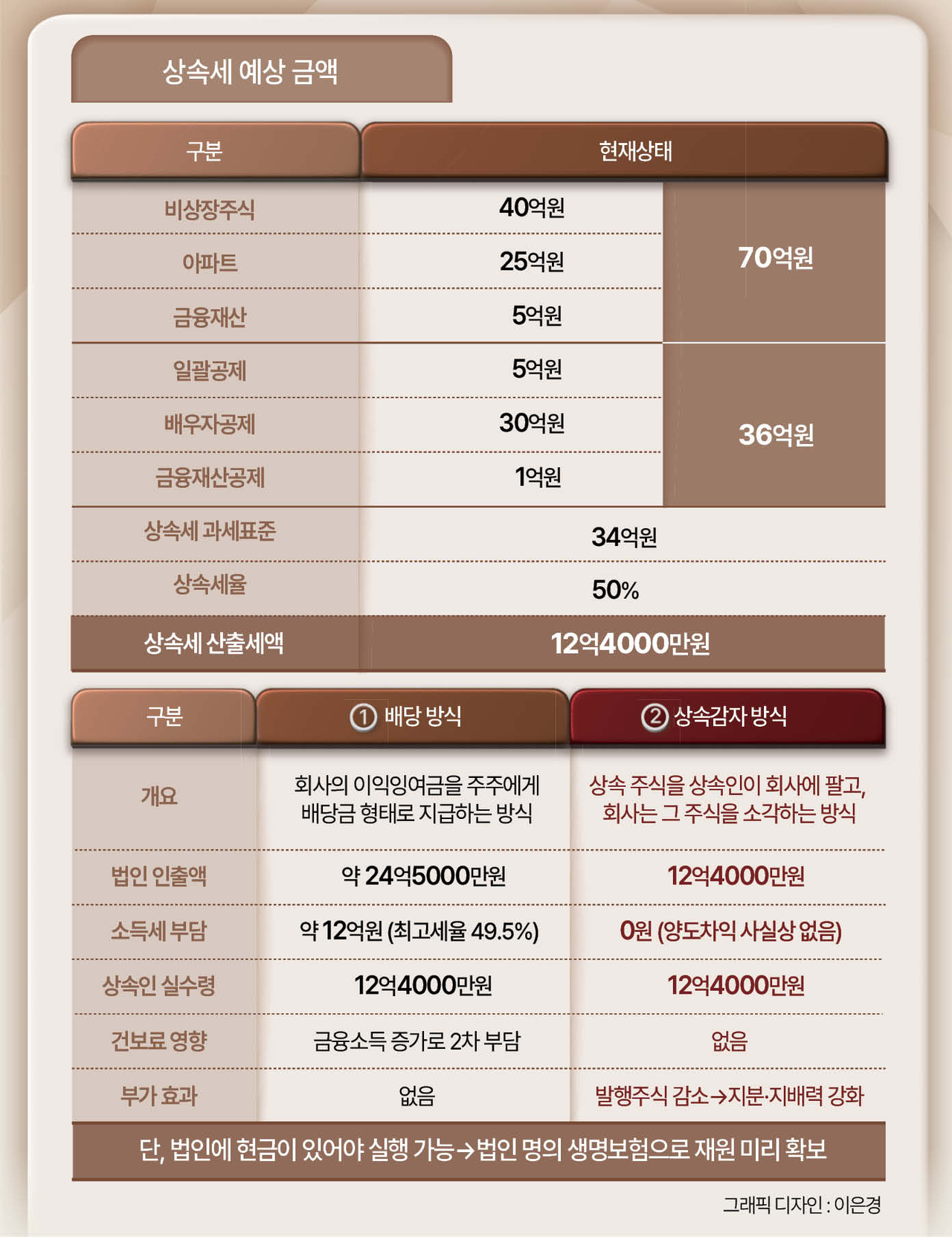
A. Start with the total estate of 7 billion won and subtract the applicable deductions. The standard lump-sum deduction is 500 million won, the spousal deduction — reflecting the share passed to a surviving spouse — is 3 billion won, and the financial asset deduction is 100 million won, for a combined deduction of 3.6 billion won. Subtracting that from 7 billion won leaves a taxable base of 3.4 billion won.
Apply the tax rates to that base. Under current law, the top rate of 50% applies to the portion of the taxable base exceeding 3 billion won. The resulting tax bill comes to approximately 1.24 billion won. Given that the OECD average inheritance tax rate is around 15%, South Korea's rate is nearly four times higher — second only to Japan (55%) globally, and well above the United States (40%) and Germany (30%).
Q. Does inheritance tax have to be paid in cash? Are there other options?
A. Cash payment in a lump sum is the rule, but it is rarely practical. Two alternatives exist — installment payment and payment in kind — but each has clear limitations.
Installment payment allows the tax to be spread over time. When the tax bill exceeds 20 million won, the taxpayer can provide collateral and pay in installments over up to 10 years — or 20 years for a family business succession — but interest charges at roughly commercial bank lending rates accrue every year. Payment in kind allows real estate or shares to be used instead of cash, but approval for unlisted shares is difficult to obtain. Even when approval is granted, the government tends to sell the shares at auction at a discount, which works against the heirs.
If a competitor or private equity fund wins the auction for those shares, management control can be lost entirely. Secured loans and real estate sales are also options, but a forced sale can depress prices or push up the assessed value of the estate, potentially increasing the inheritance tax burden rather than reducing it.
Q. Can't you just use company money? It seems simple enough to pay the tax out of dividends.
A. The math does not work out that way. Dividend income above 20 million won is aggregated with other income and subject to comprehensive taxation. At the top rate of 49.5% — including local income tax — a 1.2 billion won dividend from the company would leave the heir with only about 600 million won. Nearly 600 million won disappears in income tax.
Consider the reverse calculation. To have 1.24 billion won left after paying 49.5% in tax, the company would need to pay out roughly 2.45 billion won in dividends. In one stroke, nearly half of the retained earnings the company built up over 20 years would evaporate in taxes and the cost of funding the payment. On top of that, the increase in financial income triggers higher national health insurance premiums — a second-order burden.
Q. So what is the alternative to dividends? "Inheritance capital reduction" is said to be the answer — how exactly does it work?
A. Inheritance capital reduction is the technique used in place of dividends. The heir sells the inherited shares back to the company, and the company cancels them. The key lies in how the tax code calculates the "acquisition cost." Normally, when you sell shares, tax is levied on the capital gain — the difference between the purchase price and the sale price. Inherited shares are different. Because the heir has already paid inheritance tax on them, the tax code recognizes the appraised value at the time of death as the heir's new acquisition cost.
That is what creates the tax-saving effect. When the heir sells the inherited shares back to the company at the same appraised value, the purchase price and the sale price are in effect identical, so virtually no capital gain arises. The capital gains tax rate is 22% for ordinary shareholders and 27.5% for major shareholders (including local income tax), but because there is almost no taxable gain to begin with, the actual tax burden falls close to zero.
The result is that pulling 1.24 billion won out of the company leaves the heir with the full 1.24 billion won to pay the inheritance tax directly — saving roughly 1.2 billion won in corporate asset outflow compared with the dividend route. There is an added benefit: when the repurchased shares are cancelled, the total number of shares outstanding falls, raising the ownership percentage of the remaining shareholders. For CEO Kim, who plans to pass the business to his son, using inheritance capital reduction — without any external sale — naturally consolidates the family's shareholding and control.
Q. How does inheritance capital reduction actually work in practice? How long does it take?
A. The process typically takes two to three months and involves six steps. First come tax review and funding confirmation (one to two weeks), then a board resolution (within one week), followed by shareholder meeting approval (within two weeks). The critical stage comes next: when a company reduces its capital or acquires its own shares, the law requires a creditor objection period of at least one month to protect creditors' interests — a window that cannot be shortened by law. After that, the company must complete payment, share cancellation and, if the paid-in capital changes, capital reduction registration (one to two weeks).
Given that the inheritance tax filing deadline is six months, the window for action after a death is tighter than it may appear. If aligning the interests of shareholders, appraising the unlisted shares or securing the buyback funds takes longer than expected, the process can easily stretch beyond three months. Without a structure designed in advance while the business owner is still healthy, an effective response when the time comes will be very difficult.
Q. What are the key things to check before proceeding?
A. Three things stand out. First, the appropriateness of the transaction price. Transactions with the company or related parties at prices above or below fair market value can trigger the "denial of unfair act calculation" rule, resulting in unexpected tax assessments — which is why an independent external appraisal is essential. Second, understanding the transaction structure. If the legal requirements are not met, the transaction can be reclassified as a "deemed dividend," making it subject to dividend income tax at 49.5% rather than capital gains tax. The tax-saving effect can vanish in an instant, so the structure must be designed carefully with a tax professional.
Third, post-transaction tax risk. Below-market transfers or above-market purchases among family members are a primary target for follow-up tax investigations. Even if a transaction appears clean at the time, the tax authorities may impose additional gift tax years later based on their own assessment.
Q. The procedure and the cautions are clear — but ultimately, don't you need to have the money in the first place?
A. That is precisely where corporate life insurance comes in as a practical solution. No matter how well the inheritance capital reduction structure is designed, if the company does not have the funds to buy back the shares, the entire plan is worthless. The approach is to have the business owner take out a life insurance policy in the company's name while still in good health, structured so that the death benefit is paid to the company when the owner dies.
The structure is straightforward. The company is both the policyholder and the beneficiary; the insured is the CEO. The company pays the premiums, and when the CEO dies, the insurance proceeds flow into the company and are used directly as the buyback funds for the inheritance capital reduction. Because the company — not the individual — bears the cost, it is possible to design the coverage at a scale sufficient to handle even a large inheritance tax bill.
Above all, a shift in mindset is essential. Succession must be treated not as a personal matter but as a corporate risk, and the company must prepare for it in advance at the organizational level. Getting the tax structure right is not enough. Only by building a system that guarantees access to the necessary cash at the right moment can both the company and the family be protected.
Q. There are many types of corporate life insurance products — which one should you choose?
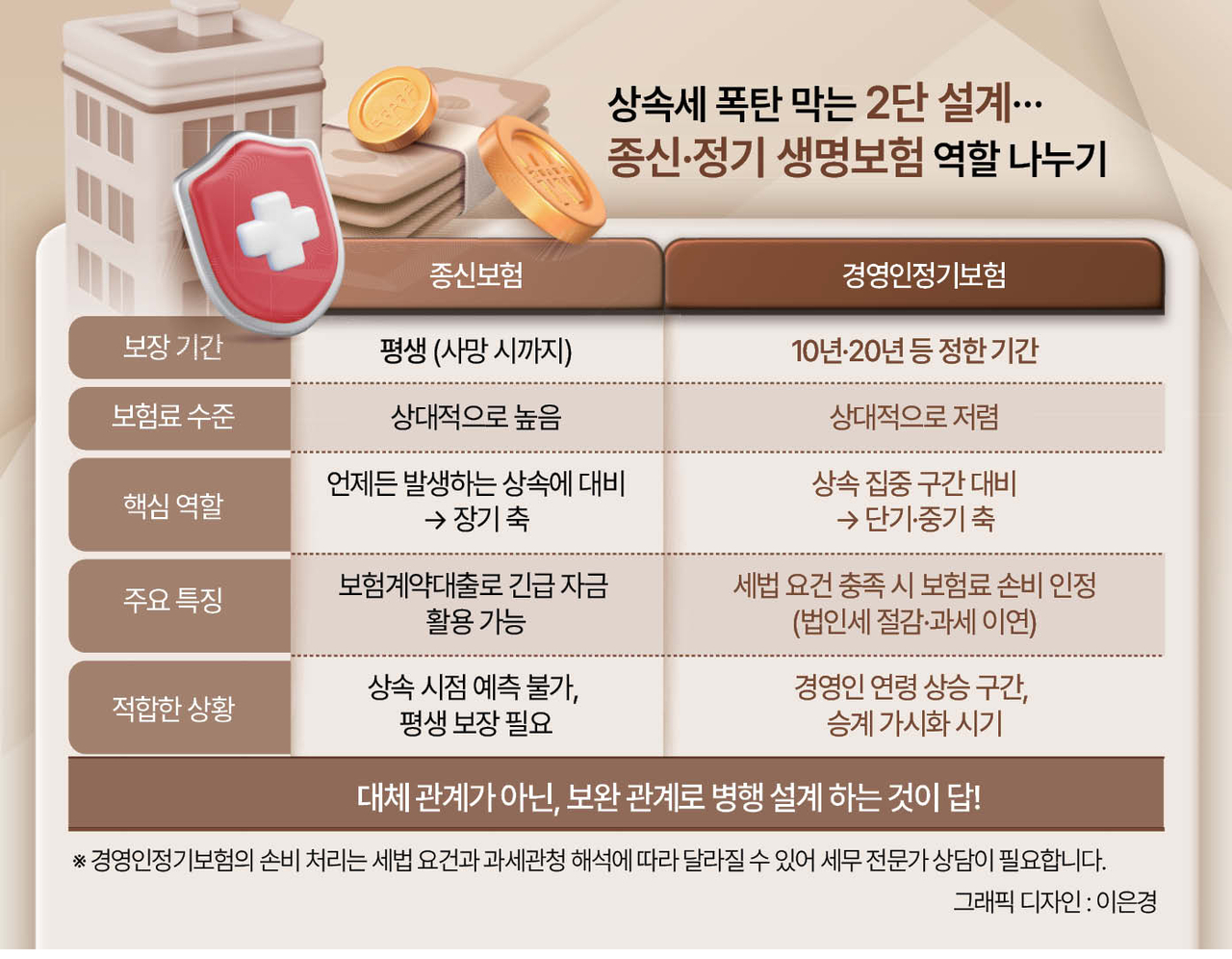
A. In practice, the standard strategy is to use both whole life insurance and executive term life insurance together. Because the timing of an inheritance cannot be predicted, the key is to have a structure that guarantees a cash payout whenever it occurs.
Whole life insurance pays out regardless of when the insured dies. It is the long-term pillar of the strategy — designed for an inheritance that could happen at any time. Coverage lasts for life, and a policy loan can be drawn against it when emergency funds are needed, providing additional flexibility.
Executive term life insurance covers only a fixed period — 10 or 20 years — but offers a much larger coverage amount for a relatively lower premium. It serves as the short- to medium-term pillar, efficiently covering the window when succession risk is most concentrated — such as when the owner is aging or a business handover is becoming imminent. When the applicable tax requirements are met, the premiums can be fully deducted as a business expense at the time of payment, offering corporate tax savings and a tax deferral effect.
The two products are not alternatives — they are complements. Only by designing both together — a structure that provides coverage at any time (whole life) alongside one that concentrates coverage over a specific period (term) — can a company manage its inheritance tax burden, preserve management control without selling equity and ensure a stable succession.
One caution: the expense deduction treatment for executive term life insurance premiums depends on tax code requirements and the tax authorities' interpretation, so consultation with a tax professional is essential. Accounting treatment also differs between companies subject to external audit and smaller firms, making a review tailored to the company's size indispensable.
By Park Sung-joon
psj@heraldcorp.com