One year of financial reform under the Lee Jae-myung administration
92 trillion won channeled into productive finance in the first quarter alone
Private sector responds to government incentives with speed
Interest burden eased and access improved for vulnerable groups
Inclusive Finance Task Force set to redesign the system
Shortly after taking office last June, the Lee Jae-myung administration established "productive finance" and "inclusive finance" as the twin pillars of its financial policy. The vision was to redirect capital flows away from real estate and toward future high-tech industries and the real economy, broadening the foundation for economic growth and redefining the role of finance.
A year on, the government has moved beyond the blueprint stage into full implementation, and tangible results are beginning to emerge. The private financial sector's strong response to the government's push has accelerated the flow of funds into key industries and toward vulnerable groups.
According to financial authorities Monday, the financial sector plans to channel approximately 1,242 trillion won (about $805 billion) into productive finance over the next five years — 616 trillion won from private institutions and 626 trillion won from policy finance. That works out to roughly 250 trillion won a year, more than 30 percent of the government's total annual budget, being injected across the real economy.
Equally notable is the pace of disbursement, which has exceeded market expectations. In the first quarter of this year alone, 92 trillion won was deployed into productive finance, including 9.9 trillion won in venture capital.
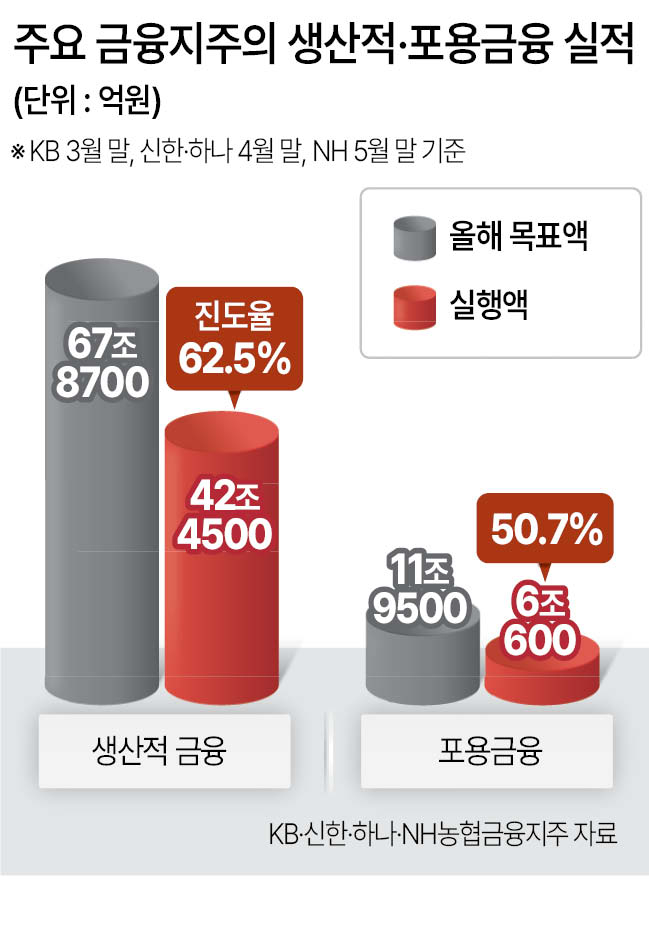
The activity of private financial groups has been particularly striking. The four major financial holding companies — KB, Shinhan, Hana and NH NongHyup — have collectively supplied 42.4472 trillion won in productive finance, reaching 62.5 percent of their combined annual target of 67.8717 trillion won.
Meanwhile, mortgage loan growth has slowed under the government's tightened lending regulations. The outstanding mortgage balance at the five major banks — KB Kookmin, Shinhan, Hana, Woori and NH NongHyup — stood at 613.388 trillion won at the end of May, up just 1.7799 trillion won from 611.6081 trillion won at the end of last December.
These shifts reflect the government's expanded incentives, including the rationalization of capital regulations. Measures such as easing risk-weighted asset requirements for lending to productive sectors have increased financial institutions' capacity to supply funds.
The most emblematic achievement of the productive finance drive is by far the National Growth Fund. The fund combines government policy capital as seed money with large-scale private investment, targeting a total of 150 trillion won to broadly support advanced strategic industries and their ecosystems.
A public participation tranche of the fund, designed to let ordinary citizens share in the gains of government-led growth, sold out its entire 600 billion won target allocation within five business days of launch. Financial authorities plan to release a second tranche in the second half of this year.
The other pillar, inclusive finance, is serving as a socioeconomic safety net. The government has focused its policy efforts on meaningfully reducing the interest burden on low-income and financially vulnerable groups and dramatically improving their access to financial services.
The government cut the special guarantee rate on Haetsal-lon, the flagship low-income policy loan, from 15.9 percent to 9.5 percent annually, and reduced the rate on loans designed to prevent illegal private lending from 15.9 percent to 6.3 percent. It also launched a low-interest livelihood loan for financially vulnerable groups and more than tripled the scale of small loans available to debt-restructuring borrowers who have maintained consistent repayments.
A sweeping debt restructuring program for long-term delinquents facing extreme financial hardship was also carried out. Through the Saedoyak Fund, a program for resolving long-term delinquent bonds, the government purchased approximately 9.1 trillion won in non-performing loans, giving a total of 750,000 people — counting overlapping cases — a path out of debt collection and back into normal economic life.
Major financial holding companies are also accelerating their inclusive finance supply in line with the government's direction. The five major financial groups plan to invest a combined 70.4 trillion won in inclusive finance over the next five years, with 13.22 trillion won earmarked for this year alone. Among them, KB, Shinhan, Hana and NH NongHyup Financial have already surpassed 50 percent of their annual targets.
A notable aspect of the inclusive finance push is that it has brought the public role of finance into the national conversation and built a degree of social consensus around the issue.
President Lee Jae-myung has repeatedly said in public forums that "the public nature of finance is weak," stressing that entrenched financial exclusion can only be rooted out by breaking the financial sector's habit of chasing profit above all else. His argument is that the foundation for inclusive finance can only be built when the sector restores its social responsibility and public role beyond profit-seeking.
Building on that conviction, the government plans to formally launch the Inclusive Finance Strategy Task Force this month to begin a comprehensive redesign of the financial system. The task force will identify and address structural factors driving financial exclusion within the market — including shortcomings in credit rating systems, prudential regulations and the role of low-income financial institutions. Policy discussions are expected to intensify around practical measures such as expanding alternative credit scoring using non-financial data and improving the mid-interest-rate loan structure.
Cho Seong-mok, president of the Korea Inclusive Finance Institute, praised the government's productive and inclusive finance drive, saying future finance "will be redefined as a model that grows together with the community, grounded in social trust, beyond mere profit generation." He also cautioned that "since the financial sector's participation has been somewhat passive, it is important for the public and private sectors to communicate fully and build shared understanding."
ehkim@heraldcorp.com