School Violence as a Survival Game, Part 3: A Lawyer's View
[Editorial note]
A punitive approach to school violence has turned classrooms into a ruthless survival game. As even minor disputes are automatically referred to school violence committees, the number of hearings has surged — yet the most common outcome is a finding of "not school violence," paralyzing schools' ability to resolve conflicts on their own. Caught in adults' proxy legal battles to protect their children's academic records, students collect evidence of each other's wrongdoing instead of offering apologies and seeking reconciliation. This series examines the structural contradictions of a school violence system that has lost sight of its core purpose — protecting victims — and become mired in legalism, told through four conflicting perspectives: parents, lawyers, teachers and students.
![School violence disputes have moved beyond the realm of educational resolution and into a vast legal market. An AI-generated image depicting a school violence specialist lawyer. [Created via ChatGPT]](https://wimg.heraldcorp.com/news/cms/2026/06/12/news-p.v1.20260610.72e92b1971154f15a03fd0cf80f0f9ed_P1.png)
By Kim Yong-jae, The Herald Business
"Ma'am, there's no time to cry. Bring me your child's phone first."
That is how lawyer A, who handles school violence cases out of Seocho-dong, describes the scene in his consultation room. When a parent arrives in tears after learning their child has been reported as a school bully, the first thing he asks for is not a letter of apology or an expression of remorse toward the victim. It is the child's KakaoTalk messages, social media accounts and generative AI records.
"If the other side has reported our child for school violence, we need to find their weaknesses too," he said. "We check everything — whether they ever used abusive language, said anything harsh in a group chat, or made physical contact, even as a joke."
School violence disputes have left the domain of educational resolution and grown into a vast legal market. Educators say the spectacle of parents and lawyers fighting over school records is fueling what they call a "school violence business."
The case of Park Jun-young (a pseudonym), a second-grade elementary school student, illustrates the point. Park was repeatedly bullied by five classmates, including being poked in the genitals. When his parents filed a school violence complaint, the accused students' families all filed counter-complaints, claiming Park had also behaved improperly.
Criminal charges were even filed against elementary school children who are not subject to criminal punishment. The children ultimately had to undergo police questioning, and the school violence committee cleared four of the five accused students.
Parents turn to lawyers as school violence cases become tied to college admissions
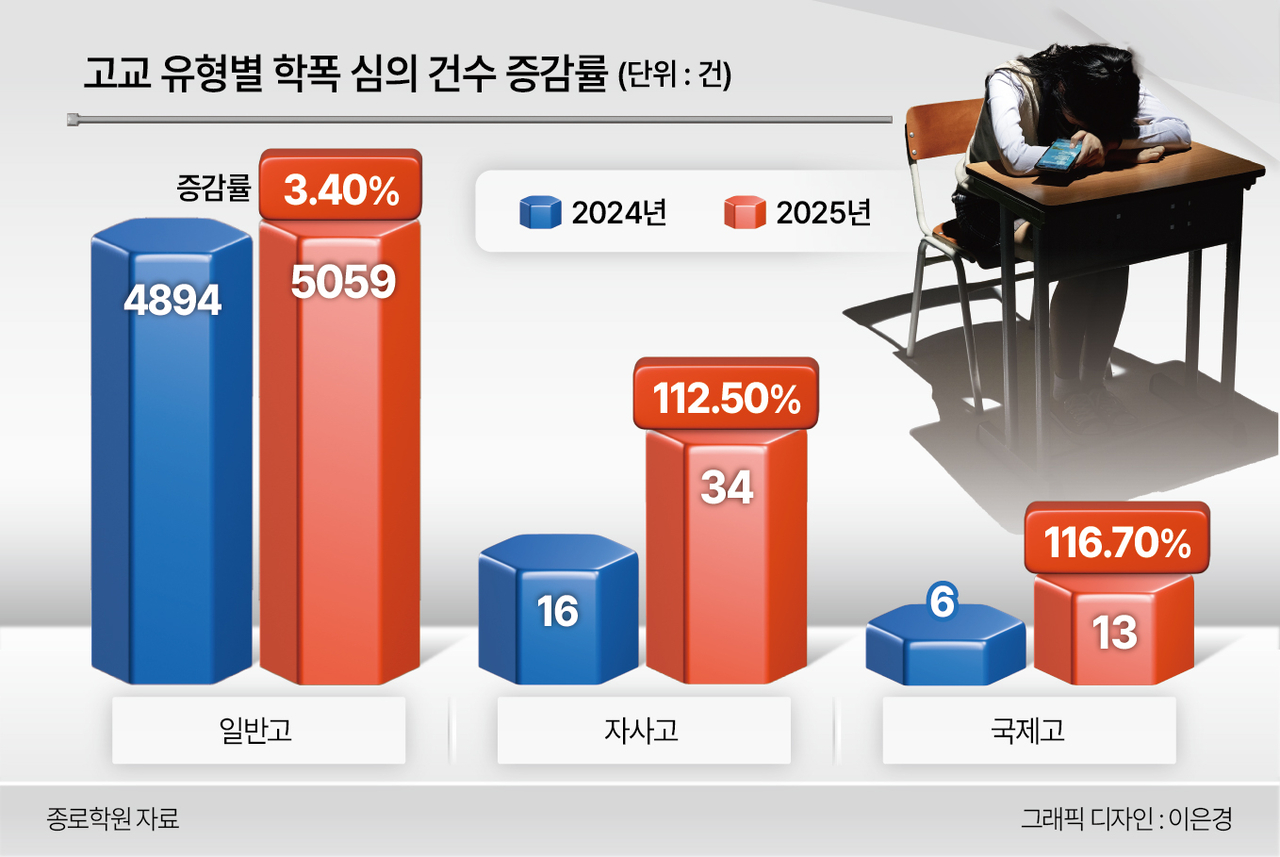
The reason even elementary school cases escalate into counter-complaints and legal battles is straightforward. Parents have come to believe that a school violence report is no longer just a school matter — it can determine their child's future. The trend is especially pronounced at autonomous private high schools and international high schools, where the number of school violence hearings has risen sharply. According to Jongno Academy, the number of cases reviewed by school violence committees at those two school types more than doubled in a single year, jumping from 16 and 6, respectively, in 2024 to 34 and 13 in 2025.
Parents are opening their wallets to protect their children's school records and college prospects. Lawyer B, who regularly handles school violence cases, said parents are willing to pay large retainer fees ultimately because of the school record. "As the weight of school violence disciplinary actions in university admissions has grown, many parents have come to treat legal fees as a kind of college admissions insurance," he said.
Fear among parents intensified after a wave of rejections hit applicants with school violence records starting with the 2026 college admissions cycle. Kim, a 44-year-old mother in Daechi-dong raising a first-year high school daughter who went through school violence litigation, said 10 million won (about $7,200) or 20 million won is not a small sum, "but I thought it was better than not getting into the university she wanted because of a school violence record."
Legal fees directly tied to college admissions are substantial. According to a lawyer who handles numerous school violence cases, drafting a written opinion for a school violence committee hearing costs around 2 million won ($1,440), while consultation and accompaniment services run about 5 million won ($3,600). If parents contest the committee's ruling through administrative appeals and administrative litigation, costs can balloon to tens of millions of won or more.
'The moment a complaint comes in, everyone starts thinking about counter-complaints and lawsuits'
Lawyers in the field say that within an unprofessional school violence committee system, students are frequently and unjustly branded as perpetrators, making a vigorous legal defense essential.
Attorney Jeong Eui-jong, who has handled juvenile cases, pushed back on how the legal profession is portrayed. "The media depicts lawyers as encouraging counter-complaints to help accused students escape responsibility, but in reality there are quite a few students who are wrongly labeled as perpetrators," he said.
He added that jokes exchanged among friends in a group chat are sometimes partially screenshotted and reported as school violence. "The school violence deliberation committee is not a court, so adequate guarantees of the right to a defense are necessary," he said.
In practice, some families do take their cases to court after finding the committee's ruling inadequate, and disciplinary levels are sometimes adjusted as a result. Parents who contest committee decisions pursue administrative appeals and administrative litigation. According to the Seoul Metropolitan Office of Education, of the 148 lawsuits filed by accused students' families to overturn school violence measures between March 2023 and February 2024, 24 were partially upheld — resulting in the cancellation or reduction of disciplinary action.
Attorney Lee Ji-su said that while many parents used to weigh apologies and mediation first, it is now common for families to immediately consider counter-complaints and litigation the moment a report is filed. "If the structure that prioritizes defending school records over restoring student relationships continues, the original purpose of the school violence system will inevitably be undermined," she said.
Educators worry that a system designed to resolve school violence is increasingly becoming an arena for legal disputes rather than a means of protecting and guiding students. The reality in 2026 is that when school violence occurs, students and parents turn to a lawyer before a homeroom teacher or school counselor, and think about gathering evidence and planning litigation before considering apologies and reconciliation. As classroom conflicts migrate to the legal market in Seocho-dong, the educational imperative of restoring student relationships has been pushed aside.
brunch@heraldcorp.com