Reforms include fivefold expansion of tax-exempt forestry income ceiling, eased land-use rules and lower barriers to entry, reflecting field-level feedback
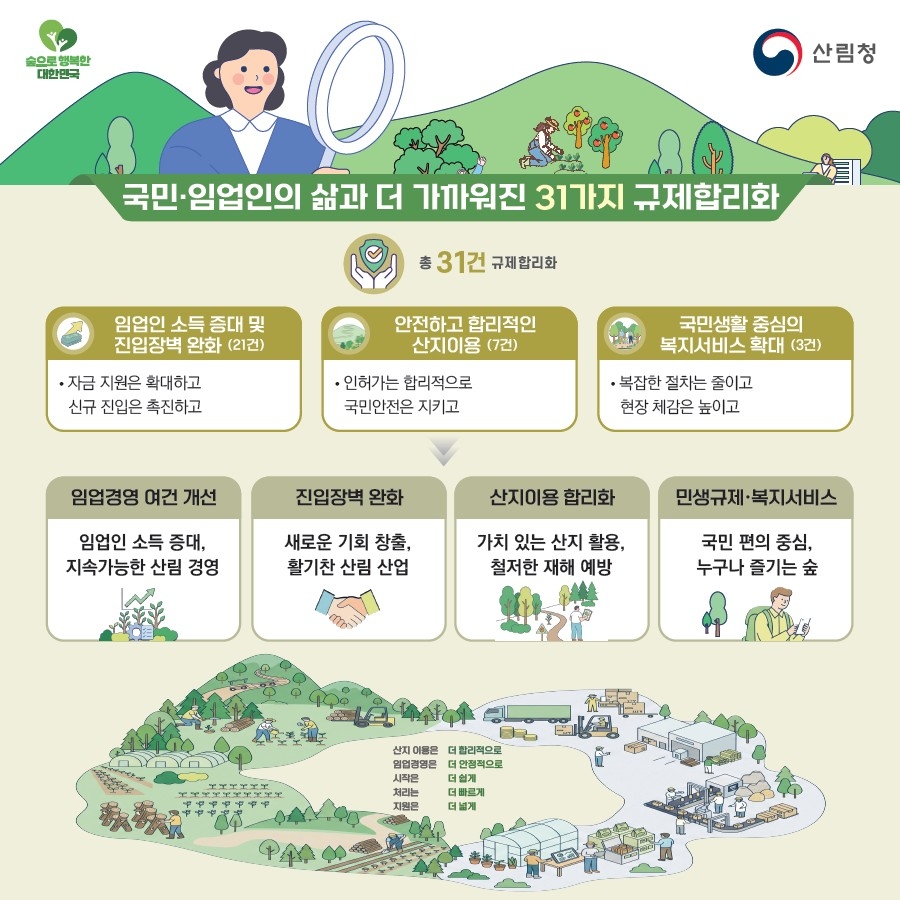
The Korea Forest Service on Monday announced representative deregulation achievements from the first year of the People's Sovereignty Government that citizens can feel directly.
Over the past year, the agency focused its deregulation drive on four areas: improving forestry management, lowering barriers to entry, rationalizing forest land use, and expanding forest welfare services — all shaped by feedback from the field.
Boosting forestry income and lowering barriers to entry (21 measures): The tax-exempt ceiling on capital gains from forestry income was raised fivefold — from 6 million won (approximately $3,890) to 30 million won per year — sharply reducing the tax burden on forestry workers. Tax support for forestry equipment was extended three years through 2028, and eligibility criteria and side-job conditions for financial support targeting people returning to mountain villages were eased to encourage new entrants into the sector.
The processing period for forest management plan approvals was also cut from 30 days to 20 days, and the criteria for applying management plans were made more flexible to reflect actual field conditions. Support standards for equipment used in forest product production and retail were significantly relaxed so that more forestry workers can access policy support.
To invigorate the beekeeping industry, 15 additional woody nectar plant species were designated. The number of documents required to apply for eco-friendly forest product certification was also reduced from five to two, easing the administrative burden.
Safe and rational forest land use (7 measures): In areas experiencing population decline, forest land regulations were eased by up to 20 percent across criteria including average slope, timber volume and elevation. The requirement to install tree-protection structures when grazing livestock on forest land was relaxed to reduce the financial burden of building livestock facilities. Environmental impact assessment standards were rationalized to focus on actual development areas, and the minimum area requirement for establishing public arboretums was lowered from 10 hectares to 2 hectares.
To strengthen safety near residential areas, felling of trees within 25 meters of a building's outer boundary is now permitted with the forest owner's consent, and the scope of landslide prevention management was expanded to cover land within 50 meters adjacent to forests. A new fire-safety review system for buildings near forests was also introduced.
Expanding welfare services centered on everyday life (3 measures): To broaden forest welfare access for large families, the qualifying threshold for multi-child households was lowered from three children under 19 to two. Parking fees at national natural recreation forests were fully waived. An online reissuance service for pine species production verification certificates was also introduced, significantly improving convenience for users.
Going forward, the Korea Forest Service plans to strengthen forest-based regional co-prosperity policies and expand new growth foundations in the forestry sector through further deregulation — including raising the allowable area for forest land conversion to promote onshore wind power development and introducing a framework for mountain village stay-type rest shelter facilities.
Korea Forest Service Commissioner Park Eun-sik said the deregulation achievements of the past year were "a direct result of incorporating voices from the field." He added that the agency would "pursue policies that put the improvement of management conditions for forestry workers and forest owners, and the convenience and safety of the public in using forests, as the top priority — working together with the people to build a Republic of Korea made happy by forests."
kwonhl@heraldcorp.com