
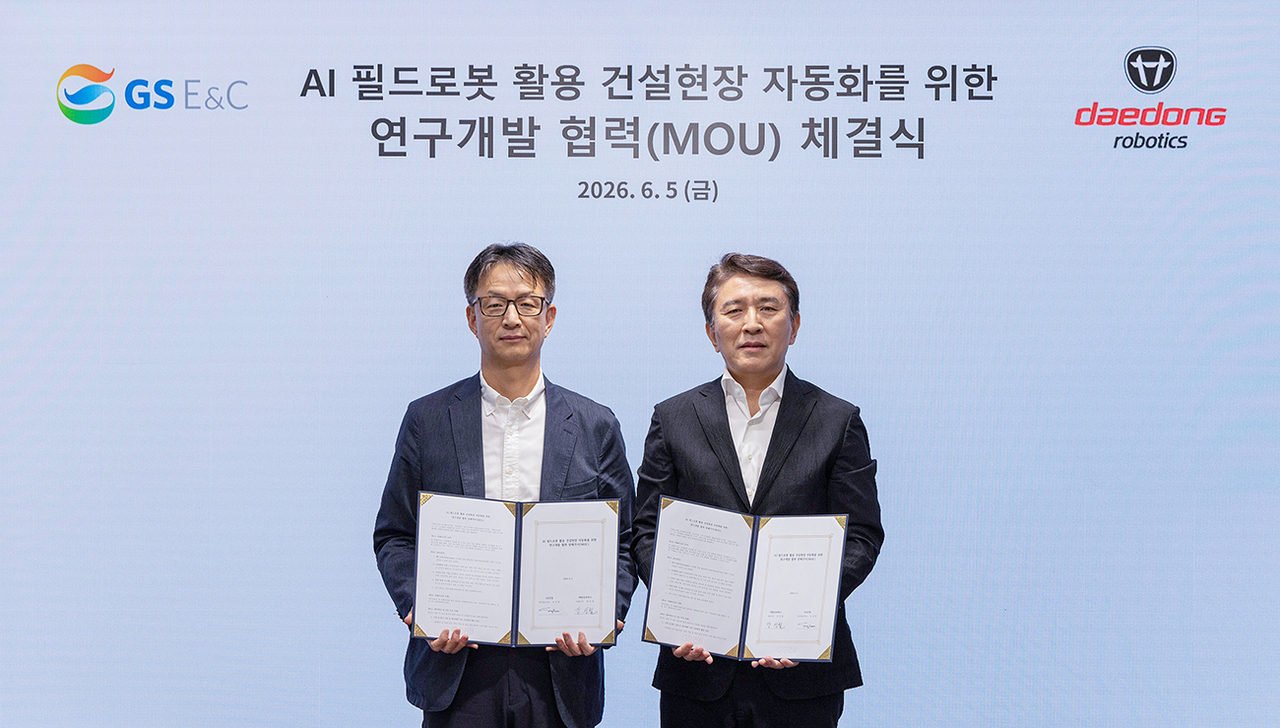
Daedong Robotics, GS E&C sign MOU for smart construction R&D
Autonomous robots to be tested for material transport, repetitive tasks
Agricultural carrier robot technology to expand into manufacturing, construction and defense
Daedong Robotics has teamed up with GS Engineering & Construction to develop AI field robots for construction sites, aiming to apply the autonomous driving and spatial recognition technology it built through agricultural robots to material transport, repetitive tasks and heavy-load movement on job sites.
Daedong Robotics, the AI robot subsidiary of Daedong Group, announced Monday that it signed an MOU with GS E&C for joint research and development in construction site automation and smart construction technology.
The agreement focuses on building a technology cooperation framework for deploying AI field robots at construction sites and jointly developing the related market. The two companies agreed to collaborate in three areas: reviewing whether existing mass-production AI field robots can be applied at construction sites, cooperating on smart construction operations and new technology, and conducting joint R&D and proof-of-concept projects for construction-specific robots.
Daedong Robotics will handle robot design and technology development tailored to construction environments, drawing on its autonomous driving robot platform. It will assess whether its existing mass-production models can be deployed at actual construction sites and participate in new robot R&D and field validation. GS E&C will provide construction sites for testing and identify operational requirements from a site manager's perspective, while also pursuing technology verification and commercialization.
Construction sites are among the unstructured work environments that robot companies are watching most closely. Unlike factories, where fixed layouts and routines repeat predictably, construction sites see constant changes in material locations, pathways and work sequences, along with dust, uneven surfaces, obstacles and heavy foot traffic. Deploying autonomous robots in such environments requires not just basic navigation but also 3D spatial recognition, obstacle avoidance, collaboration with workers and remote monitoring capabilities.
Daedong Robotics points to its agricultural robot development experience as a key differentiator. Farmland, like construction sites, is an unstructured environment with irregular terrain and obstacles. The company launched an agricultural carrier robot early last year and became the first in South Korea to obtain certification for an autonomous agricultural carrier vehicle. It currently holds technology in indoor and outdoor autonomous driving, vision AI and multi-sensor-based 3D spatial recognition, large language model-based voice interfaces, and multi-robot operation and control.
The company's ambitions extend well beyond agriculture. Daedong Robotics has already supplied coal-spillage cleanup robots and in-house logistics robots, and is now developing construction material transport robots and other construction-site equipment. It plans to expand robot development for industrial sectors including factories and construction sites, and aims to transition to a data-driven Robot-as-a-Service platform by 2030.
For Daedong Group as a whole, the partnership carries broader strategic significance. The group has been shifting its business focus from farm machinery toward smart agriculture, mobility and robotics. Daedong Robotics, established in October 2024, started with agricultural carrier robots and has since set its sights on the industrial robot market spanning manufacturing, construction and defense. The GS E&C collaboration could serve as the first real test of whether robotic technology developed in agricultural settings can hold up at large-scale construction sites.
Construction companies are also feeling growing pressure to adopt robots. The sector faces a simultaneous squeeze from an aging workforce, a shortage of skilled labor, tightening safety regulations and pressure to shorten project timelines. Material transport and repetitive tasks in particular carry high worker fatigue and significant safety risks. There is growing expectation that robots could partially replace or assist in these areas, reducing labor burdens and improving on-site safety.
According to market research firm Mordor Intelligence, the global construction robot market was valued at approximately $442 million (roughly 640 billion won) in 2025 and is projected to grow at a compound annual rate of 15.5 percent, reaching $909 million by 2030. Demand is rising to apply robots to on-site processes such as material transport, repetitive tasks, inspection and surveying, driven by labor shortages and advances in smart construction technology.
"Construction sites are the ideal expansion stage for Daedong Robotics, as they concentrate repetitive tasks and heavy-load transport in unstructured environments — exactly where the technology and know-how we have built up in agricultural settings can be put to use," Daedong Robotics CEO Kang Sung-chul said. "We will combine GS E&C's extensive field experience with Daedong Robotics' field-validated AI technology to deliver real results in construction automation."
hong@heraldcorp.com




