
Circuit breaker triggered 3 minutes after open; Kosdaq also halted by sell-side sidecar
Foreign selling accelerates as US semiconductor stocks tumble, won weakens sharply
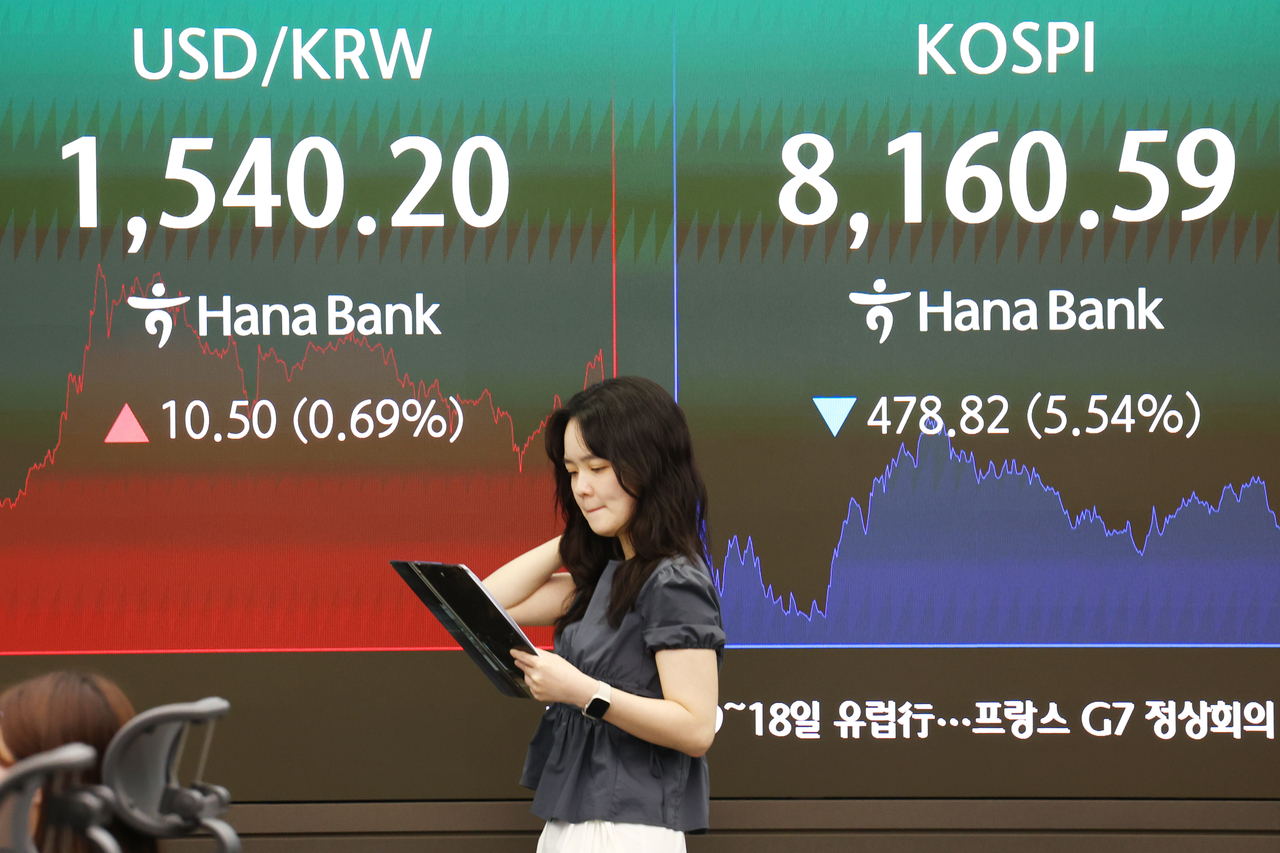
The Kospi shed more than 8 percent in early trading Monday, falling below the 8,000-point threshold as tumbling US semiconductor stocks and a weakening won sent markets into a broad selloff. Samsung Electronics dropped below the 300,000-won mark and SK Hynix fell under 2,000,000 won simultaneously. A circuit breaker was triggered just three minutes after the opening bell, and a sell-side sidecar was activated on the Kosdaq market as well.
According to Korea Exchange, the Kospi was trading at 7,477.46 as of 9:04 a.m., down 683.13 points, or 8.37 percent, from the previous session. The index had opened down 112.50 points, or 1.38 percent, at 8,048.09 before extending its losses sharply.
As the selloff deepened immediately after the open, Korea Exchange activated a circuit breaker on the main bourse at 9:03:42 a.m.
Foreign investors posted net selling of 342.1 billion won ($247 million) on the main market. Institutions and retail investors were net buyers of 142.1 billion won and 207.1 billion won, respectively.
Large-cap stocks fell across the board. Samsung Electronics dropped 30,500 won, or 9.27 percent, to 298,500 won, slipping below the 300,000-won level. SK Hynix fell 166,000 won, or 8.02 percent, to 1,904,000 won, sliding under the 2,000,000-won mark.
Other major stocks also declined sharply, including SK Square (down 11.53 percent), Hyundai Motor (down 10.00 percent), Samsung Electro-Mechanics (down 9.16 percent), LG Energy Solution (down 3.99 percent), Samsung Life (down 14.91 percent), HD Hyundai Heavy (down 4.97 percent) and Samsung C&T (down 12.27 percent).
The Kosdaq also tumbled more than 7 percent, with the index standing at 928.34 as of the same time — down 74.10 points, or 7.39 percent, from the previous session. A sell-side sidecar was triggered on the Kosdaq around 9:06 a.m.
On the Kosdaq, foreign investors and institutions were net buyers of 68 billion won and 13.5 billion won, respectively, while retail investors were net sellers of 57.5 billion won.
The sharp decline on Wall Street late last week dealt a direct blow to domestic markets. Nonfarm payrolls for May, released by the US Department of Labor, came in well above market expectations, reigniting concerns that the Federal Reserve could raise interest rates before year-end. Nvidia fell 6.20 percent and Micron dropped 13.25 percent, while the Philadelphia Semiconductor Index plunged 10.26 percent.
"The psychological burden from the chain reaction of sharp declines in domestic and overseas semiconductor stocks last Friday cannot be overlooked," said Han Ji-young, a researcher at Kiwoom Securities. "The key question is whether macro data, earnings results and supply-demand events during the week can provide a turning point to restore investor sentiment that has turned so cold."

hajun825@heraldcorp.com




