
Hosted by the US, Mexico and Canada
Field expands from 32 to 48 teams
39 days, 104 matches — the longest and largest ever
Heat, injuries and countdown rules among key variables
![Mexico City Stadium, where the opening ceremony and season opener of the 2026 FIFA World Cup will be held [Getty Images]](https://wimg.heraldcorp.com/news/cms/2026/06/08/news-p.v1.20260608.0f213f05199b4bfcaec467a935ccf2db_P1.jpg)
The 2026 FIFA World Cup — the world's biggest soccer event — kicks off Friday in North America.
The tournament runs through July 19, spanning 39 days across three co-host nations: the United States, Mexico and Canada. It marks the first World Cup co-hosted by three countries, and the first shared hosting since the 2002 Korea-Japan edition 24 years ago.
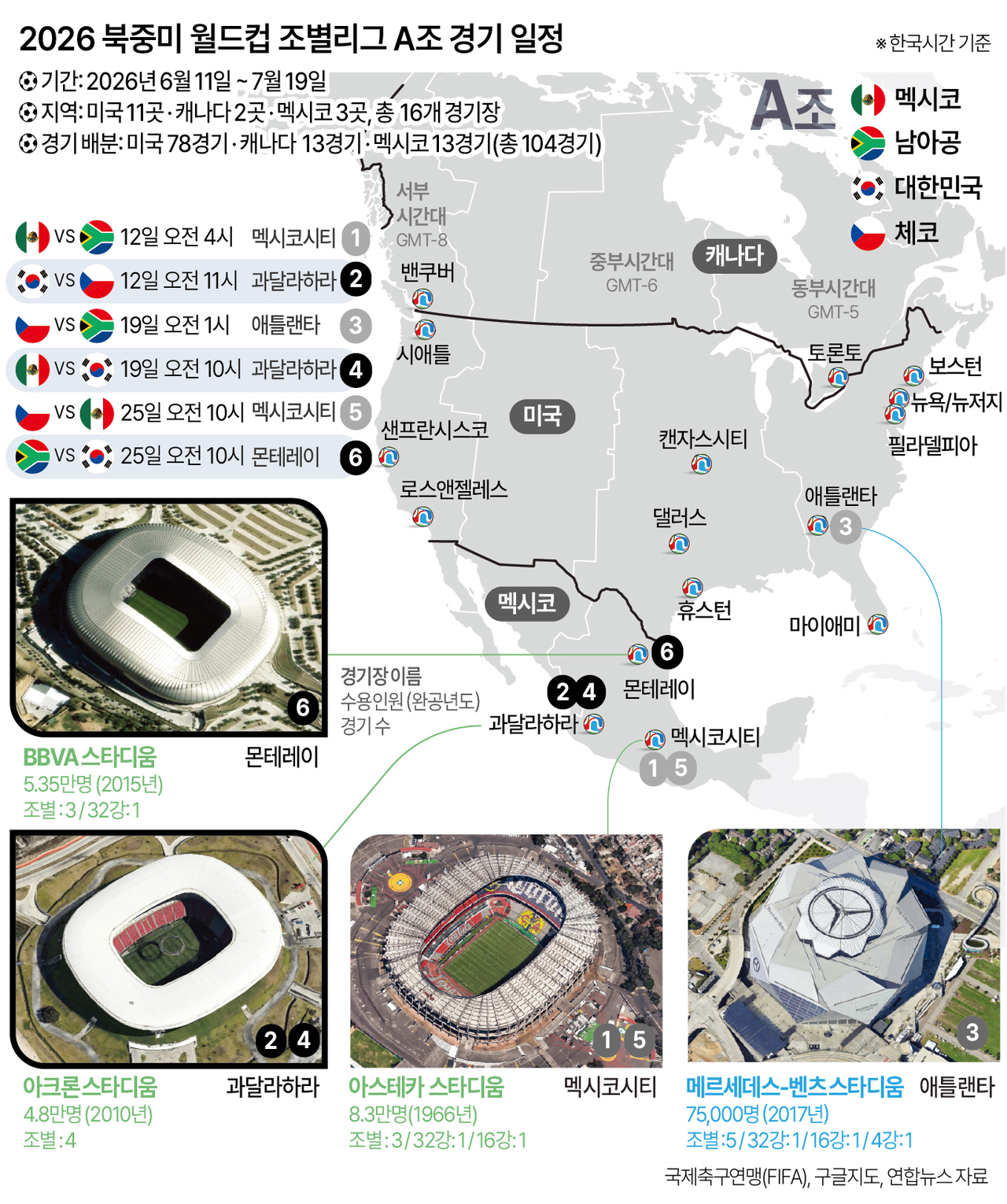
The official season opener takes place Friday at 4 a.m. Korean Standard Time at Estadio Azteca in Mexico City, where Mexico faces South Africa. The final is set for July 20 at 4 a.m. KST at MetLife Stadium in East Rutherford, New Jersey.
Each host nation will hold its own opening ceremony. Mexico City's goes first, beginning at 1:30 a.m. KST on Friday, followed by Toronto's at 10:30 a.m. KST the same day. The US ceremony at LA Stadium takes place Saturday at 8:30 a.m. KST.
At the Mexico City ceremony, Shakira and Burna Boy are set to perform the official tournament anthem "Dai Dai." Alanis Morissette and Michael Bublé headline the Toronto show, while the US event features Lisa of BLACKPINK alongside Katy Perry, Rema and Anitta.
The tournament's marquee performance comes at halftime of the final on July 19 — the first halftime show in World Cup history, a format previously seen only at the NFL's Super Bowl. BTS, Madonna and Shakira are among the confirmed performers. FIFA aims to raise $100 million for global children's education through the show.
The most significant structural change in this World Cup is the expansion of the field from 32 to 48 teams, with the total number of matches nearly doubling from 64 to 104 — both all-time records.
The group stage features 12 groups of four teams each. The top two finishers from each group — 24 teams in all — advance to the round of 32, joined by the eight best third-place finishers. From there, the tournament proceeds through a knockout format: round of 32, round of 16, quarterfinals, semifinals and the final.
The expanded match schedule puts a greater premium on squad fitness and injury management for teams that advance deep into the tournament. Scorching summer heat across North America in June and July adds another layer of concern.
![Estadio Guadalajara in Guadalajara, Mexico, where South Korea faces the Czech Republic in their Group A opener at 11 a.m. KST on Friday [Getty Images]](https://wimg.heraldcorp.com/news/cms/2026/06/08/news-p.v1.20260608.7110c1def36f40d7a8013b5a1741a7d5_P1.jpg)
This World Cup is widely expected to be the last for two of the sport's all-time greats: Lionel Messi, 38, of Argentina and Cristiano Ronaldo, 41, of Portugal.
Messi has scored 116 goals in 198 international appearances, including 13 in 26 World Cup matches. He lifted the trophy at the 2022 Qatar World Cup on his fifth attempt, scoring seven goals and adding three assists across seven matches from the group stage to the final. He earned the Golden Ball as best player and the Silver Boot as the tournament's second-highest scorer.
Messi said after Qatar that it would be his last World Cup, but he has yet to retire from international duty, setting the stage for one final chapter in North America.
Ronaldo has scored 143 goals in 226 international appearances — eight in 22 World Cup matches — and has won UEFA Euro 2016 and the UEFA Nations League in the 2018-2019 and 2024-2025 seasons, but the World Cup has eluded him throughout his career.
His best finish at the tournament remains fourth place, achieved at his debut World Cup in Germany in 2006. At the 2022 Qatar edition, Portugal fell in the quarterfinals.
![Lionel Messi (left) and Cristiano Ronaldo [Getty Images]](https://wimg.heraldcorp.com/news/cms/2026/06/08/news-p.v1.20260608.36188837ad754f11b9cf80b291c01d7a_P1.jpg)
Two players will make their World Cup debuts this year: Erling Haaland, 25, of Norway and Lamine Yamal, 18, of Spain. Together with Kylian Mbappé, 27, of France, they rank among the most valuable players in the world today.
Haaland has scored 55 goals in 49 international appearances and led Norway to its first World Cup in 28 years. Norway topped European qualifying Group I ahead of Italy, with Haaland scoring 16 goals in eight matches.
Yamal turned professional in 2023 at just 15 and was called up to the national team the same year. At UEFA Euro 2024, he contributed one goal and four assists across six matches as Spain won the title. He is now seen as the player most likely to lead Spain to a second World Cup title since their 2010 triumph in South Africa.
Mbappé, runner-up at the 2022 Qatar World Cup after winning in Russia in 2018, is hungry to reclaim the title. He has scored 56 goals in 96 international appearances and 12 goals in 14 World Cup matches. Four more goals this tournament would make him the all-time leading scorer in World Cup history.
The current record holder is Miroslav Klose of Germany, who scored 16 goals across four World Cups from the 2002 Korea-Japan edition through the 2014 Brazil tournament.
![Erling Haaland (left) and Lamine Yamal [Getty Images]](https://wimg.heraldcorp.com/news/cms/2026/06/08/news-p.v1.20260608.99fc0f9657d24f1291e8a2991c93d3f4_P1.jpg)
This tournament introduces hydration breaks for the first time. The breaks give players three minutes to rehydrate — once after the 22nd minute of each half.
The concept resembles the cooling breaks used at the 2014 Brazil World Cup, but with a key difference. Cooling breaks were triggered at the discretion of medical staff when the wet-bulb globe temperature exceeded 32 degrees Celsius; hydration breaks apply regardless of weather conditions.
FIFA mandated the breaks in response to concerns about intense summer heat during the North American tournament. Some observers have noted that the breaks effectively turn soccer — a sport with no timeouts outside of halftime — into a four-quarter game.
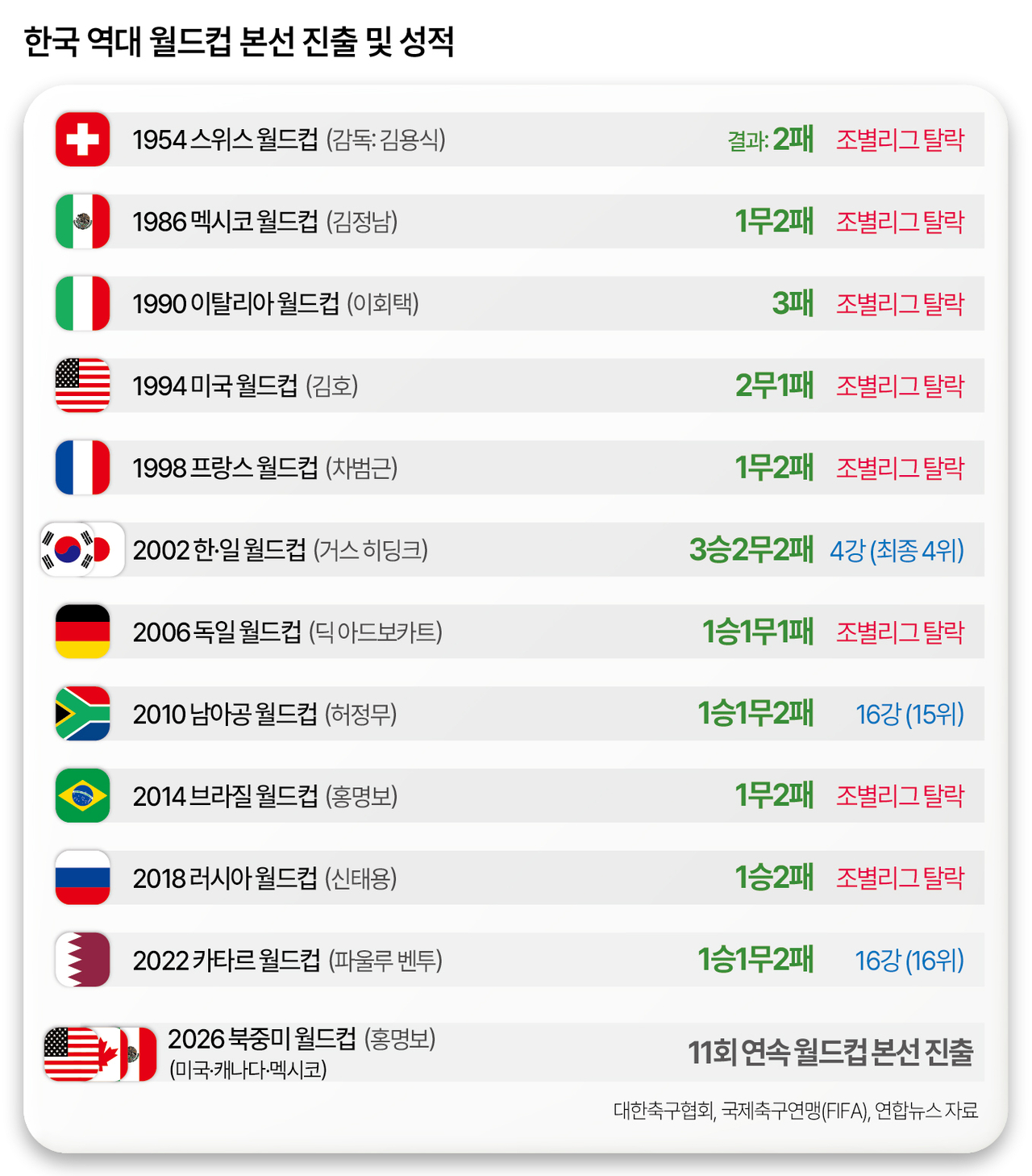
South Korea's national team, managed by Hong Myung-bo, has firsthand experience of how disruptive the breaks can be. In a friendly against Ivory Coast in March, Korea lost control of the game after the first-half hydration break and went on to lose 4-0. The squad has since incorporated the breaks into its training regimen.
Another significant rule change is the introduction of countdown timers for throw-ins, goal kicks and substitutions. If a referee determines that a throw-in or goal kick is being deliberately delayed, a five-second countdown begins. Failure to restart in time results in the ball being turned over to the opposing team — a throw-in becomes the opponent's throw-in, and a goal kick becomes a corner kick for the opposition.
Substitutions are subject to a 10-second countdown. Once the referee signals a change, the outgoing player must leave the field within 10 seconds; if not, the incoming substitute must wait one minute before entering.
A rule targeting time-wasting through feigned injuries has also been introduced. A player who receives treatment for an injury during play must leave the field and wait one minute after play resumes before returning.
VAR review will also expand beyond its existing scope — goals, penalty decisions, straight red cards and mistaken identity in disciplinary calls. It will now also cover corner kick decisions, second yellow card dismissals and cases of mistaken identity in foul calls.
yjc@heraldcorp.com




