
Analysis of customers who switched from secondary to primary lenders shows loan approval rates up 8 percentage points, credit card limits up 1.22 million won; credit improvement seen driving virtuous cycle in financial transactions; wave of refinancing products launched amid inclusive finance push
![[Created using ChatGPT]](https://wimg.heraldcorp.com/news/cms/2026/06/05/news-p.v1.20260529.6fcbde6607f546a78de68fe94fa658b4_P1.png)
"I just refinanced my loan — and my credit score jumped 50 points?"
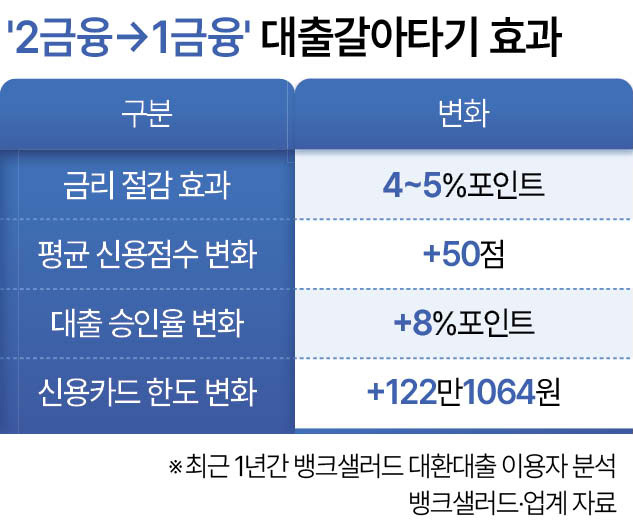
Borrowers who refinance out of secondary financial institutions and into banks see their credit scores rise by an average of roughly 50 points, according to new data, confirming what the industry has long assumed. The improvement also triggers a broader virtuous cycle: loan approval rates climb and credit card limits expand by more than 1.2 million won. Banks are rolling out a wave of refinancing products aimed at pulling secondary-lender borrowers into the lower-rate banking sector, in line with the government's inclusive finance push.
The Herald Business confirmed through loan-comparison platform Banksalad that customers who used its loan-switching service over the past year and moved from secondary to primary lenders posted an average credit score gain of 50 points. The sharpest individual improvement belonged to a 43-year-old woman whose score surged 211 points — from 749 to 960.
Financial industry officials say the act of refinancing out of a secondary lender itself carries positive weight in credit assessments. Credit bureaus factor in the type of loan, the tier of lender, and repayment history, so reducing exposure to higher-rate, higher-risk secondary-sector debt can directly improve a borrower's credit profile.
Credit bureau KCB assigns a 38 percent weighting to the nature of a borrower's credit transactions, while NICE weights debt-burden information — including loans and guarantee obligations — at 24.5 percent.
The credit improvement translated into measurable gains elsewhere. Average loan approval rates among the borrowers studied rose 8 percentage points, and average credit card limits increased by 1,221,064 won ($797). The size of the benefit can vary depending on a borrower's starting score, even when the point gain is identical.
Industry observers consider a 50-point gain substantial. The "credit score booster" features commonly offered by financial apps — which submit non-financial payment records such as national pension contributions, national health insurance premiums and phone bills to credit bureaus — typically raise scores by only 3 to 40 points.
A Banksalad official said the platform is working to bring refinancing products for the secondary-to-primary switch onto its marketplace, so that inclusive finance products can be linked directly with its credit and loan services.
Major financial holding companies are also stepping up mid-rate refinancing programs for low- to mid-credit borrowers, expanding their inclusive finance product lineups. The industry estimates that switching a loan from a secondary lender to a bank typically cuts the interest rate by around 4 to 5 percentage points.
Woori Financial launched its "Woori WON Dream Refinancing Loan" on May 27. The group-wide product lets low- to mid-credit customers who hold loans with Woori's card, capital or savings bank affiliates refinance into a lower-rate bank loan, with a maximum limit of 20 million won ($13,070).
The product carries a minimum rate in the mid-4 percent range annually and caps the maximum at under 7 percent per year. Preferential rates are available for socially vulnerable customers and inclusive finance customers rated in the seventh credit band or below.
Hana Bank plans to launch "Hana One Q Mid-Rate Loan" this month, a 2 trillion won ($1.31 billion) product exclusively for low- to mid-credit borrowers. Targeting borrowers in the bottom 50 percent of credit scores, it will offer a fixed annual rate of 5.5 percent on loans of up to 10 million won ($6,535) through year-end. The product includes a refinancing feature that lets borrowers switch secondary-lender debt — including savings bank loans — into bank-sector loans, with the aim of reducing interest burdens and supporting credit improvement.
Next month, Shinhan Bank plans to expand eligibility for its refinancing loan beyond existing Shinhan Savings Bank customers to borrowers at any of the country's 79 savings banks. The expanded product will target savings bank credit-loan holders who have been employed for at least one year and earn at least 20 million won ($13,070) annually. NH NongHyup Financial Group also plans to launch a primary-lender refinancing product before year-end, overhauling its alternative credit scoring system so that customers previously denied bank loans can gain access.
Competition among banks to capture secondary-lender borrowers is expected to intensify as the inclusive finance policy drive gains momentum. Financial regulators plan to conduct regular reviews of major financial holding companies' refinancing performance.
Financial holding companies are also considering incorporating the volume of borrowers successfully moved from secondary to primary lenders into their key performance indicators. "Rather than mechanically expanding mid-rate loan supply, a better model is building a 'financial ladder' that lets diligent borrowers climb from secondary lenders to banks," a commercial bank official said.
forest@heraldcorp.com




