Seoul mayoral race seen as rebuke of real estate policy
Government had insisted on no easing of reconstruction excess profit recapture
Experts expect review of planned regulatory tightening
![An apartment construction site in Banpo, Seocho-gu, Seoul. [Yonhap]](https://wimg.heraldcorp.com/news/cms/2026/06/05/rcv.YNA.20251229.PYH2025122911780001300_P1.jpg)
Momentum behind full enforcement of the reconstruction excess profit recapture regime — which requires reconstruction apartment association members to pay levies proportional to home price gains — appears to be stalling. The government had insisted there would be no easing of the system and had planned to push ahead with enforcement after the local elections, but analysts say the election of People Power Party candidate Oh Se-hoon as Seoul mayor has made it politically impossible to proceed without adjusting course, given the public mood on real estate.
Real estate sentiment erupts — enforcing reconstruction levy as written now looks untenable
According to the redevelopment industry, 34 complexes in Seoul that applied for management and disposal plan approval on or after Jan. 2, 2018 fall under the reconstruction excess profit recapture regime. Of those, 29 are concentrated along the Han River belt — one in Yongsan-gu, one in Yangcheon-gu, three in Yeongdeungpo-gu, 10 in Seocho-gu, five in Gangnam-gu, six in Songpa-gu, two in Gangdong-gu and one in Seongdong-gu. When those complexes are completed, excess profits from recent home price gains will be subject to recapture.
The market had expected the first enforcement case to emerge as soon as the local elections were over. The complex most likely to be first was Banpo Raemian Triinone (Banpo 1 District, Block 3) in Seocho-gu, due for completion in August. As of last October, the total levy across all association members was estimated at 562.14 billion won (about $368 million), working out to roughly 300 million won per member among the 1,557 association members. With Seocho-gu's officially assessed land values rising 22.07% this year, the actual levy was expected to climb even higher.
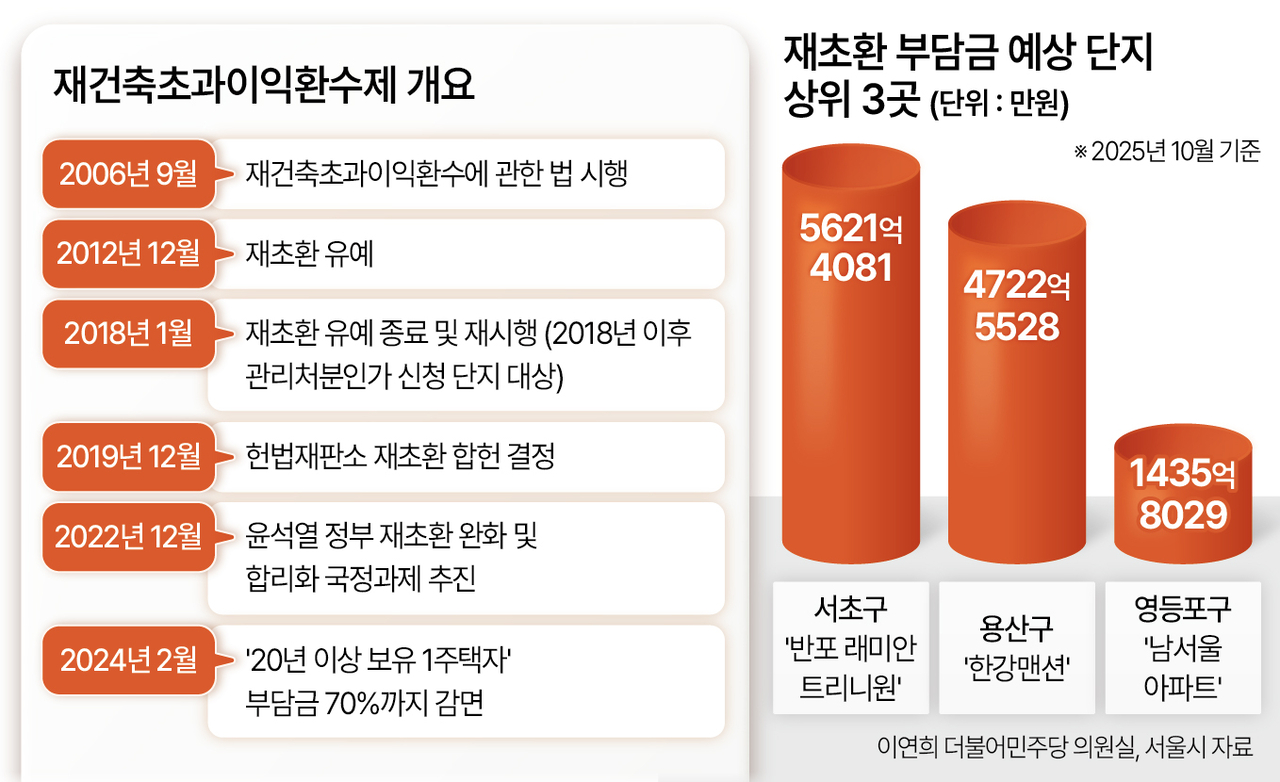
Analysts now say the government will find it hard to push through full enforcement of the reconstruction excess profit recapture regime, as the local election results are being read as a direct expression of public frustration over real estate policy. Experts say the Seoul mayoral race gave voice to demands from both residents and the redevelopment industry for regulatory relief in the housing market.
Calls for a slowdown are surfacing within the government itself. An anonymous government official said that with reconstruction complexes now completing this year, "it has become difficult to delay the reconstruction excess profit recapture any further," but added: "Whether the government, having now seen what voters think through this election, can actually enforce the levy exactly as written — that is an open question."
Government that insisted 'no adjustment' on reconstruction levy may be reversing course
The reconstruction excess profit recapture regime requires that when profits from a reconstruction project exceed 80 million won per association member, up to 50 percent of the excess is recaptured. The excess profit is calculated by subtracting the property's value at the start of the project — measured at the date of association establishment approval — along with normal housing price appreciation and development costs, from its value at completion. Because the levy grows with the final property value, the system has long been seen as a punitive tax targeting high-priced homes in the Gangnam area.
The market had expected the regime to take effect in earnest once the June 3 local elections concluded. The system was enacted into law in 2006 but was effectively shelved for roughly two decades before being revived under the Moon Jae-in administration to apply to complexes that filed for management and disposal plan approval from January 2018 onward. Complexes subject to the levy have been completing construction one after another this year, and the law requires levies to be imposed within five months of completion.
Land, Infrastructure and Transport Minister Kim Yun-deok repeatedly said "no adjustment has been discussed" regarding the reconstruction excess profit recapture regime. After public sentiment on real estate soured within the Democratic Party following the Oct. 15 real estate measures, calls for abolishing or easing the levy gained traction. But Kim drew a clear line at a New Year press briefing in January, saying: "We are currently pursuing approval and licensing support to invigorate redevelopment projects, but we have never reviewed abolishing the reconstruction excess profit recapture regime or easing floor-area ratio limits for private redevelopment projects."
On the ground, however, the very existence of the regime is widely cited as a drag on housing supply. A significant share of Seoul's new housing comes through redevelopment projects, and industry participants say the unpredictable levy burden is chilling activity in that sector.
Government may ease pace of excessive regulations
Critics most often cite double taxation on high-priced homeowners and the excessive burden on association members as the leading arguments for abolishing the reconstruction excess profit recapture regime. When a homeowner sells, they already owe capital gains tax and other levies; adding a recapture charge on top means the same income is effectively taxed twice.
One association member in Seocho-gu said longtime residents who have lived in the same apartment for 30 to 40 years or more may be forced out of their homes because they cannot afford cash levies running into the hundreds of millions of won. "Abolition is the answer — that is what association members are saying," the person said.
With that sentiment now reflected in the Seoul mayoral election result, analysts say the government may revise the system to minimize resistance. Under the current levy formula, when the average excess profit per association member exceeds 280 million won, the levy rate reaches 50 percent of the excess. Experts say the most likely adjustment would be lowering that rate.
Kim Je-gyeong, director of Toomi Real Estate Consulting Research Institute, said development contribution charges carry a maximum rate of 20 percent, and called the 50 percent reconstruction levy "a divisive system designed to catch only Gangnam reconstruction complexes."
![Sale and wolse listings posted at a real estate agency in Seoul. [Yonhap]](https://wimg.heraldcorp.com/news/cms/2026/06/05/rcv.YNA.20260531.PYH2026053107300001300_P1.jpg)
Beyond the reconstruction levy, there is renewed speculation that the government may also slow its planned tightening of regulations on high-priced homes, multi-home owners and non-owner-occupied properties, adjusting the pace to reflect market conditions. Since the government rolled out a series of policies emphasizing owner-occupancy of a single home, jeonse and monthly rental listings in Seoul have been disappearing rapidly and jeonse prices have been rising sharply. A balloon effect has also emerged in unregulated areas such as Dongtan in Hwaseong and Gwanggyo.
Seoul jeonse prices rose 0.29 percent in the first week of June compared with the previous week, outpacing the sale price increase of 0.25 percent, according to the Korea Real Estate Board. Sale prices held the same rate of increase as the prior week, while jeonse prices accelerated from the previous week's 0.26 percent gain, extending a strong upward trend.
In Gyeonggi Province, Dongtan in Hwaseong — which sits outside the regulated zone — posted a particularly sharp increase. Dongtan sale prices surged 0.60 percent, led by transit-oriented complexes in Cheongye and Yeoul-dong, recording the highest increase in the country. That marks five consecutive weeks of widening gains since the first week of last month, when prices rose 0.25 percent.
In the June 3 Seoul mayoral race, People Power Party candidate Oh Se-hoon carried 10 of Seoul's 25 autonomous districts — Gangnam, Gangdong, Gwangjin, Dongjak, Seocho, Songpa, Yangcheon, Yeongdeungpo, Yongsan and Jung-gu — areas that broadly track the city's reconstruction project map.
![서울 표심, 재건축 지도 따랐다 [부동산360]](https://wimg.heraldcorp.com/news/cms/2026/06/05/news-p.v1.20250501.cabf5ded08914a9e90dff6a276b9ed3f_T1.jpg)
hss@heraldcorp.com