China May sales up 56% from prior month
Export-hub strategy targets 120,000 units annually
Hyundai Canada, Kia Mexico post record monthly sales
Aggressive World Cup marketing drive underway
![A Beijing Hyundai dealership. [Provided by Hyundai Motor]](https://wimg.heraldcorp.com/news/cms/2026/06/05/news-p.v1.20241213.a6ef74fbc526457a8b94639899842fa2_P1.jpg)
The global marketing impact of the 2026 North America World Cup is already showing up in China for Hyundai Motor Co, even before the tournament kicks off. Beijing Hyundai, which had struggled for an extended period, posted a recovery in both domestic sales and exports in May, adding momentum to the automaker's strategy of leveraging its official FIFA World Cup sponsorship to drive sales growth.
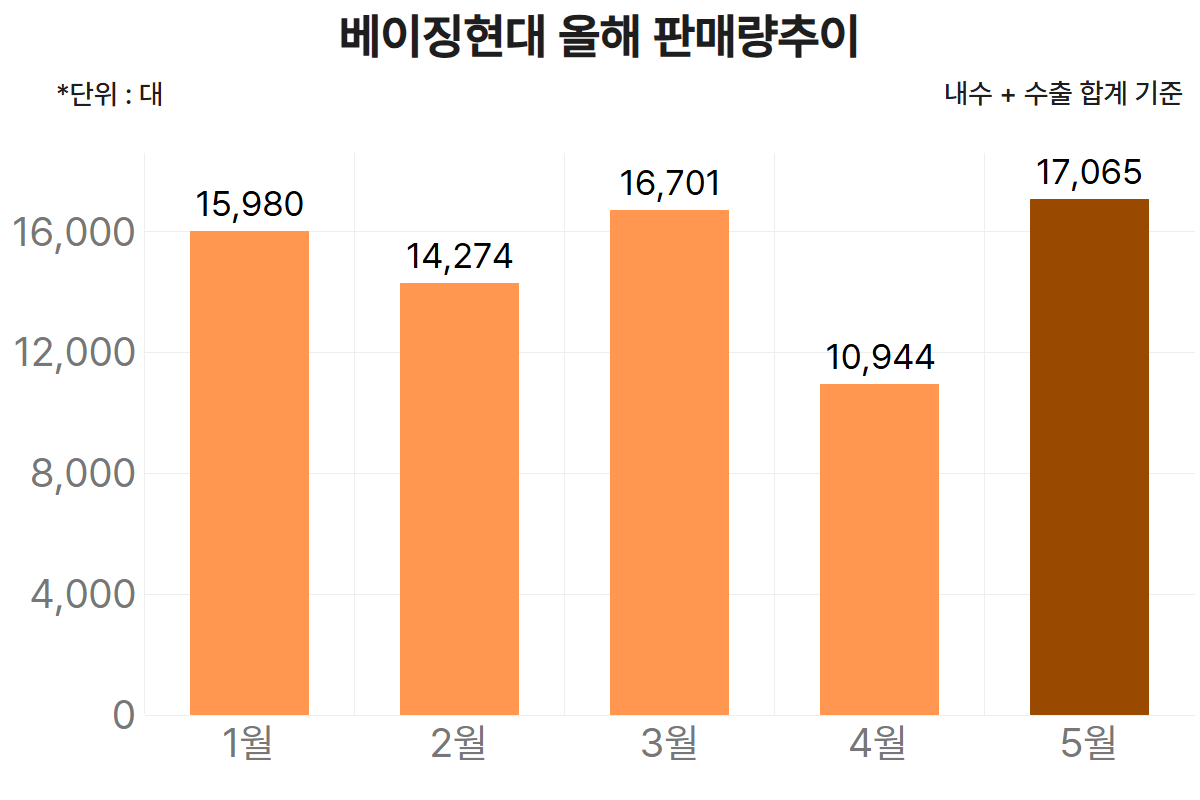
According to Chinese automotive industry sources, Beijing Hyundai sold a combined 17,065 units in domestic and export markets in May. That represents a 55.9 percent increase from the previous month and a 30.5 percent rise from the same period last year. While the exact domestic-to-export breakdown was not disclosed, domestic sales are understood to account for roughly 60 percent of the total. Export volume rose 99.4 percent month-on-month and 67.1 percent year-on-year.
Beijing Hyundai's monthly sales trajectory this year has been sharply uneven. From January through March, the joint venture sold a cumulative 50,378 units — up 12.3 percent year-on-year — driven by discounted clearance sales and steady demand for select flagship models. April brought a sharp reversal, with sales falling to just 10,944 units, down 26.57 percent year-on-year, as a broader demand slowdown swept China's auto market. Sales hit their lowest point of the year before rebounding in May to recover the 17,000-unit threshold. Cumulative sales for January through May reached 78,387 units.
The recovery was led by mass-market flagship models. Sales of the new Elantra (sold domestically as the Avante), the 11th-generation Sonata and the new Tucson L all rose sharply from the previous month. These three models form the backbone of Beijing Hyundai's China sales, and the brand has been driving their recovery through improved price competitiveness and enhanced product specifications.
A surge in export volume is also cited as a key factor behind Beijing Hyundai's improved performance. The joint venture ships sedans and SUVs to the Middle East, Southeast Asia and Latin America from three major production bases in Beijing, Changzhou and Chongqing. As competition among joint-venture brands intensifies inside China, overseas exports have emerged as a new growth pillar supporting factory utilization rates and cash flow.
Beijing Hyundai has set an export target of 120,000 units for this year — roughly 46 percent more than the approximately 82,000 units it exported last year. If the current pace holds, hitting that target looks increasingly achievable. Over the medium to long term, the company plans to raise exports to more than half of total sales by 2030 and expand annual export volume to around 200,000 units, building a structure of 300,000 units sold domestically in China and 200,000 units exported abroad.
![The new Tucson L, Beijing Hyundai's China-specific SUV. Beijing Hyundai staged a sales rebound last month on the strength of the Tucson L and other flagship models. [Provided by Beijing Hyundai]](https://wimg.heraldcorp.com/news/cms/2026/06/05/news-p.v1.20260605.2ebd91271fb646ae9453a2b9c8326bb8_P1.jpg)
Product strategy is also being recalibrated. Beijing Hyundai in May launched a new Tucson L equipped with a 1.5-liter turbocharged engine and intelligent driving features, reinforcing its SUV lineup. The Ioniq V, unveiled at the Beijing Motor Show in April, is on track for a second-half launch this year. The company has also set a target of introducing 20 new models over the next five years and building annual sales capacity of 500,000 units by 2030. Underpinning the strategy is an 8 billion yuan (approximately $1.18 billion) capital injection completed in 2024, which is intended to sustain sales of existing internal-combustion-engine models while expanding the brand's eco-friendly vehicle lineup.
Beijing Hyundai is treating the 2026 North America World Cup, which opens this month, as a major catalyst for sales growth. Hyundai Motor is the only automaker among global car brands to hold official FIFA World Cup sponsorship, and it has placed that status front and center in its China promotions. Throughout June, Beijing Hyundai is running a "Champion Edition" special offer on the new Elantra, the 11th-generation Sonata and the Tucson L. The Elantra starts at 72,900 yuan (about 16.5 million won), while the Sonata and Tucson L are each priced from 119,900 yuan (about 27 million won).
![The Ioniq V, the Ioniq brand's first China-localized model, set for launch in the second half of this year. [Provided by Hyundai Motor]](https://wimg.heraldcorp.com/news/cms/2026/06/05/news-p.v1.20260424.bae0b17f6ce342b7be0dbdec4c693486_P1.jpg)
Buyers will receive cash benefits worth 1,888 yuan applicable directly against the vehicle price, along with trade-in subsidies. Customers who participate in a World Cup winner-prediction event will be entered into a draw for four years of auto insurance coverage. The campaign is designed to go beyond simple sponsorship exposure by tying brand visibility directly to purchase incentives, with the aim of converting interest into sales.
The World Cup marketing push extends well beyond China. In Canada, Hyundai Motor and Genesis combined to sell 16,004 units in May, setting an all-time monthly sales record. Year-on-year growth was modest at 1 percent, but the record came at a moment of heightened brand exposure ahead of the North America World Cup — a timing the company views as significant.
![Boston Dynamics' Atlas humanoid robot performing a rabona kick. [Captured from Hyundai Motor Group's YouTube channel]](https://wimg.heraldcorp.com/news/cms/2026/06/05/news-p.v1.20260528.313f3665e24b405784bed3fbd524247f_P1.gif)
In Mexico, Kia sold 9,305 units in May, its best monthly performance of the year. The figure was up 5 percent from the same month last year, giving Kia a 7.3 percent share of the local market and placing it fifth in cumulative year-to-date sales in Mexico. World Cup Edition variants of the K3, K4 and Sportage — launched in February — have also been well received locally and are seen as contributing to the sales uptick.
Hyundai Motor Group plans to use the World Cup not merely as a sports sponsorship platform but as a stage to showcase its future mobility technology. During the 2026 North America World Cup, which runs from June 11 across the United States, Mexico and Canada, Boston Dynamics' Atlas humanoid robot and its four-legged robot Spot will be deployed at select stadiums. The robots are expected to assist with match operations, fan engagement programs, and safety and efficiency improvements.
"China's auto market will sustain volumes for now through policy support and price competition, but domestic growth is likely to slow after 2027 as subsidies are reduced and prices normalize," an industry official said. "Local factories in China will find it increasingly difficult to maintain utilization rates on domestic demand alone, so structurally, there is no choice but to grow the share of exports to markets such as the Middle East and Southeast Asia over the long term."
![금빛 물들인 ‘아이오닉 V’…디자인·기능, 중국인에 눈도장 [오토차이나 2026]](https://wimg.heraldcorp.com/news/cms/2026/04/27/news-p.v1.20260425.8ba32bcf755f4affa6de3b6a3bb28c7b_T1.jpg)
kwater@heraldcorp.com