With 41 reconstruction and redevelopment complexes, Songpa-gu needed smarter analysis of where to place donated public facilities. The district has built the country's first AI-powered analysis system for such facilities — trained on more than 200 types of big data and launching in July.
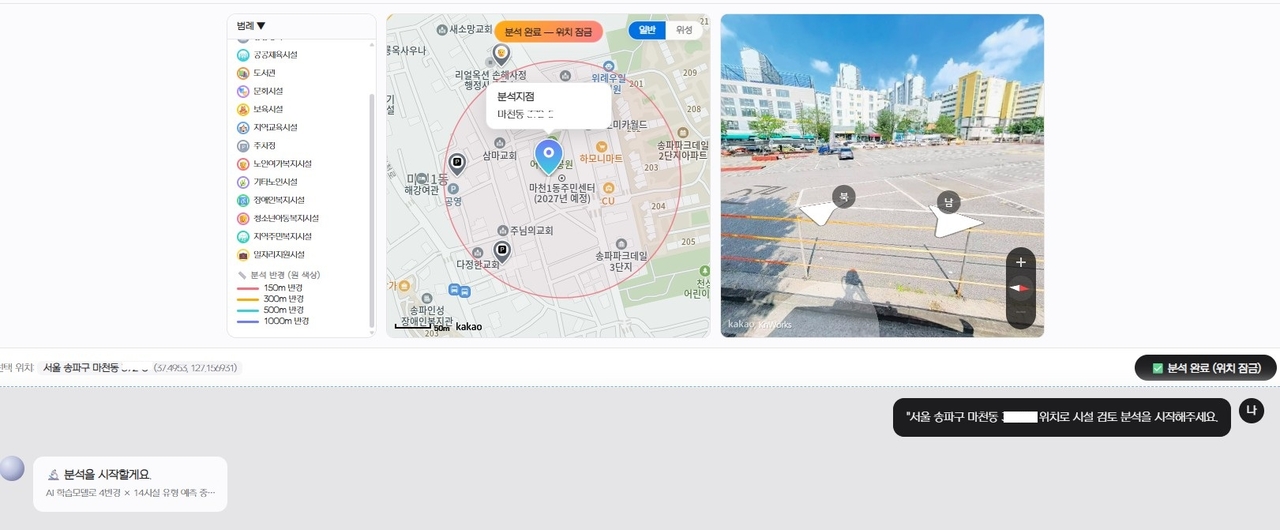
"Analyze what public facilities would be needed near the new community center going into Macheon 1-dong."
A single typed question from a staff member — and the answer came back immediately. The top recommendation was a resident welfare facility with caregiving functions; second was a small library and lifestyle cultural center; third was a community support space offering health and counseling services. A table broke down whether existing facilities within 150, 300, 500 and 1,000 meters of the site were sufficient or lacking. The system generated a final report on the same screen.
Seoul's Songpa-gu announced Thursday that it has become the first local government in the country to build an AI-powered analysis system for determining the optimal placement of public facilities acquired through land donation during reconstruction and redevelopment projects.
Songpa-gu currently has 41 reconstruction and redevelopment complexes underway, and large officetel developments are also active in transit-oriented areas and commercial zones across the district. As each project wraps up, donated public facilities are set to follow in succession. Until now, decisions on what facilities to place where relied mainly on requests from the relevant departments — a process that needed to be broadened to account for residents' lifestyle conditions and connections between facilities.
In response, the district developed its own analysis system combining big data and AI, with the goal of placing public facilities in the most suitable locations based on data on residents' lifestyle patterns and local conditions.
The district office's Smart City Division built the system in collaboration with other departments at no additional cost. It pairs AI — trained on more than 200 types of data including population figures, household counts, traffic volume, single-person household rates and existing facility inventories — with a geographic information system. The AI, pre-trained on population, residential and commercial data from across the country, assesses neighborhood conditions and identifies which of 14 types of public facilities are needed. It can also draw comparisons with other areas of similar characteristics.
The system's standout feature is its natural-language conversational AI interface. Staff can ask in plain language, "What facilities does this neighborhood need?" — and the AI understands the intent and responds. No specialized search terms or complex data processing are required.
Data gathered during the analysis — including residential and daytime population figures, apartment and villa distributions, and building use types — can be viewed at a glance through charts. The system then compiles a final analysis report on the same screen, which can be downloaded in multiple file formats for immediate use.
The district plans to put the system into full operation in July, after completing a pilot run. It will use the findings to expand tailored public facilities that meet the specific needs of local residents.
"As reconstruction and redevelopment accelerate, we needed a more thorough way to assess donated public facilities," Songpa-gu District Mayor Seo Gang-seok said. "Drawing on data that reflects how residents actually live, we will build the right facilities in the right places for every neighborhood."
seouldream01@heraldcorp.com