
Progressive era returns in education
Sweep of Greater Seoul area extends 12-year advantage
Conservative incumbents fall in Gyeonggi, Gangwon and Jeju
Seven of 10 sitting superintendents win re-election
Policies on autonomous private schools, civic education set to gain momentum
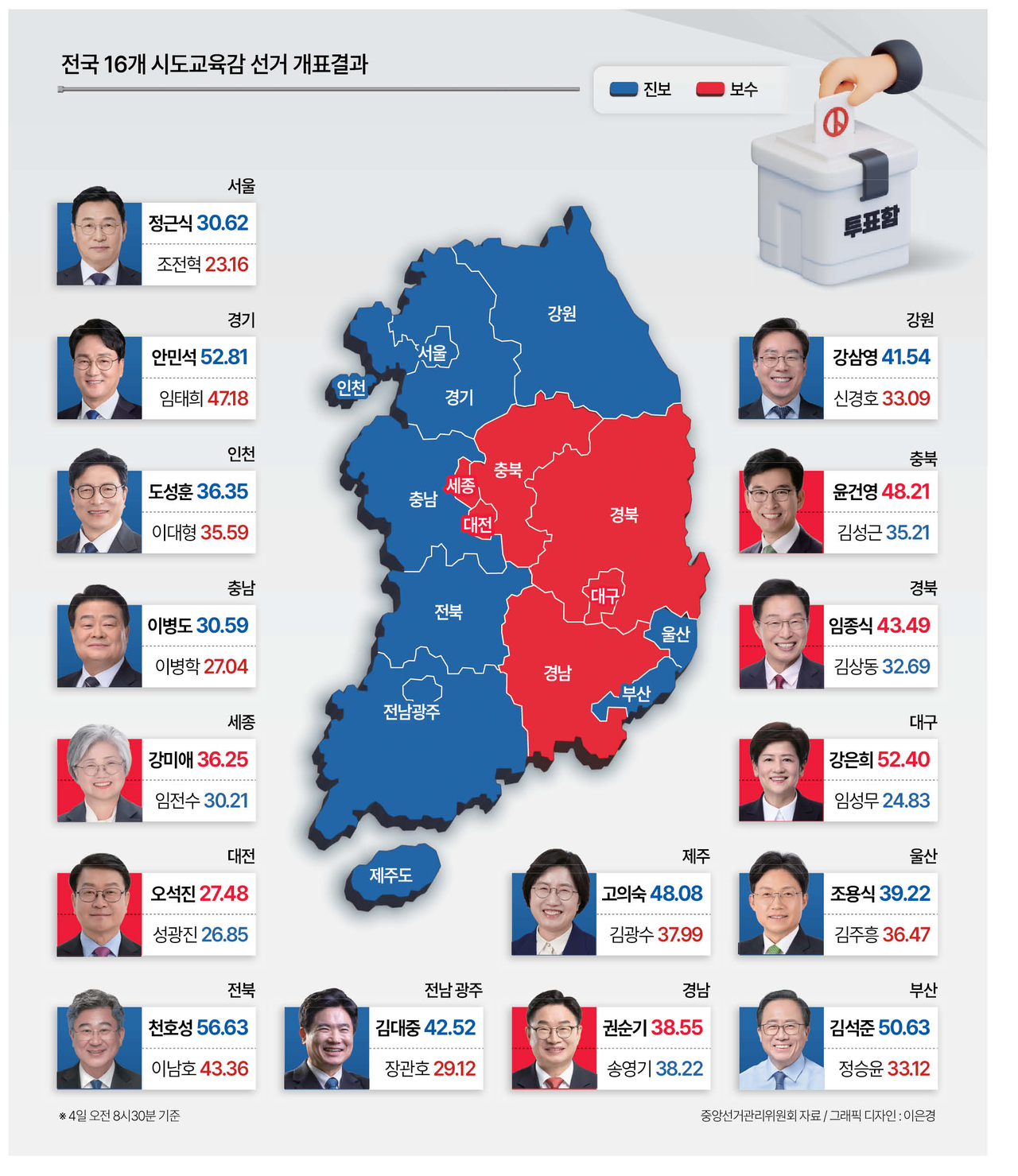
Progressive school superintendents are set to reclaim dominance in South Korean education for the first time in four years. In Wednesday's nationwide superintendent elections, progressive-leaning candidates won in 10 of the country's 16 regions. Progressive candidates swept all three Greater Seoul constituencies — Seoul, Incheon and Gyeonggi Province — and the results reaffirmed the enduring advantage of incumbency.
According to the National Election Commission's vote count as of 10:50 a.m. Thursday, the 10 regions where progressive candidates led were: Kang Sam-young in Gangwon Province, Jeong Geun-sik in Seoul, Do Seong-hun in Incheon, Jo Yong-sik in Ulsan, Ahn Min-seok in Gyeonggi Province, Kim Dae-jung in South Jeolla Province and Gwangju, Cheon Ho-seong in North Jeolla Province, Kim Seok-jun in Busan, Ko Eui-suk in Jeju and Lee Byeong-do in South Chungcheong Province.
Conservative candidates led in six regions: Kang Eun-hee in Daegu, Im Jong-sik in North Gyeongsang Province, Yun Geon-yeong in North Chungcheong Province, Kang Mi-ae in Sejong, Oh Seok-jin in Daejeon and Kwon Sun-gi in South Gyeongsang Province. In South Gyeongsang, conservative candidate Kwon had staged a dramatic comeback to take the lead as of the same time.
The progressive advantage in superintendent elections will now extend to a 12th consecutive year following the June 3 local elections. Progressives had previously dominated the field, producing 13 winning superintendents in 2014 and 14 in 2018. That number dipped to nine in the 2022 elections, but the overall edge held.
Every incumbent progressive superintendent who ran this cycle won, underscoring the power of incumbency. In Seoul, where a record eight candidates competed, incumbent Jeong Geun-sik cleared 30 percent to win re-election — his second term following a by-election victory. In Incheon, incumbent Do Seong-hun secured 36.35 percent to narrowly defeat conservative challenger Lee Dae-hyeong, who received 35.59 percent, earning Do a third term.
In Busan, incumbent Kim Seok-jun won 50.63 percent to defeat conservative Jeong Seung-yun, who received 33.12 percent, becoming the first superintendent in the country to win a fourth term. In the combined South Jeolla Province-Gwangju race — created by an administrative merger — South Jeolla incumbent Kim Dae-jung took 42.52 percent to defeat Jang Gwan-ho, who received 29.12 percent.
In regions where progressive incumbents stepped aside due to term limits or decisions not to seek re-election, progressive successors carried the torch. In South Chungcheong Province, where three-term incumbent Kim Ji-cheol departed, progressive Lee Byeong-do won 30.59 percent to defeat conservative Lee Byeong-hak, who received 27.04 percent. In Ulsan, where incumbent Cheon Chang-su chose not to run again, progressive Jo Yong-sik took 39.22 percent to edge out conservative Kim Ju-hong, who received 36.47 percent.
In North Jeolla Province, where former superintendent Seo Geo-seok vacated the seat after an election law violation, Cheon Ho-seong won with 56.63 percent, defeating fellow progressive Lee Nam-ho, who received 43.36 percent. However, in Sejong — left vacant after former superintendent Choi Kyo-jin departed to become education minister — conservative-leaning Kang Mi-ae took 36.25 percent to defeat progressive Im Jeon-su, who received 30.21 percent.
In Gyeonggi Province, Gangwon Province and Jeju, where sitting superintendents were conservative, progressive challengers prevailed. In Gyeonggi, a head-to-head race between incumbent Im Tae-hee and five-term former Assembly member Ahn Min-seok ended with progressive Ahn winning 52.81 percent to Im's 47.18 percent. In Gangwon, progressive Kang Sam-young took 41.54 percent to defeat incumbent Shin Gyeong-ho — who had received a first-instance ruling voiding his election on bribery charges — who received 33.09 percent. In Jeju, progressive Ko Eui-suk won 48.08 percent to defeat conservative incumbent Kim Gwang-su, who received 37.99 percent.
In the three remaining regions where conservative candidates led, incumbency proved decisive. In Daegu, conservative Kang Eun-hee — seeking to become the first woman to win a third term as superintendent — coasted to 52.4 percent against progressive Im Seong-mu's 24.83 percent. In North Gyeongsang Province, conservative incumbent Im Jong-sik, also seeking a third term, led with 43.49 percent over fellow conservative Kim Sang-dong's 32.69 percent. In North Chungcheong Province, conservative incumbent Yun Geon-yeong won 48.21 percent to defeat progressive Kim Seong-geun, who received 35.21 percent.
The progressive surge is widely attributed to an electoral environment that broadly favored the progressive camp. Analysts say voters appeared to expect education policy under the Lee Jae Myung administration — itself a progressive government — to align with progressive priorities.
Incumbency remained a powerful factor as well. Superintendent races typically draw lower voter attention than other contests, giving sitting superintendents an advantage in name recognition and organizational strength — conditions that have historically produced many re-election and third-term victories. Seven of the 10 incumbent superintendent candidates won.
With progressive superintendents now holding a commanding majority, policies such as abolishing autonomous private high schools, strengthening civic education, expanding student rights and public education, and broadening education welfare are expected to gain momentum. On May 15, 15 progressive superintendent candidates — including Jeong Geun-sik, Ahn Min-seok and Cheon Ho-seong — jointly declared shared campaign pledges to convert autonomous private and foreign-language high schools into general high schools and to guarantee teachers' basic political rights.
The winning progressive superintendents are also expected to accelerate collective action through the Council of Metropolitan and Provincial Superintendents of Education. The body serves as a forum for regional education policy advocacy and coordinates education policy with the Ministry of Education.
brunch@heraldcorp.com




