Boneless drumstick, wingette and whole drumstick menus all reduced in weight; first such case since mandatory chicken weight labeling took effect six months ago
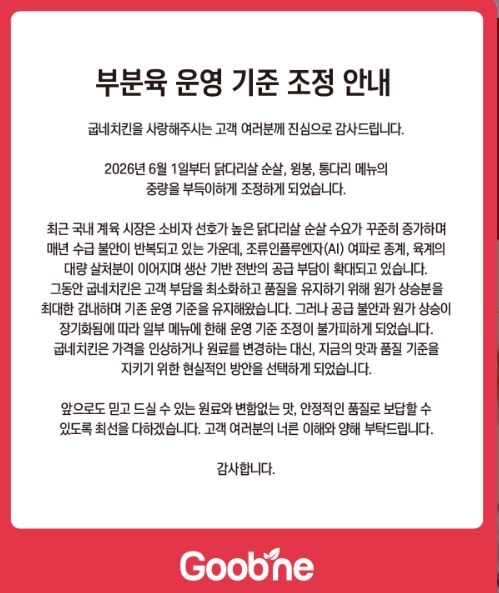
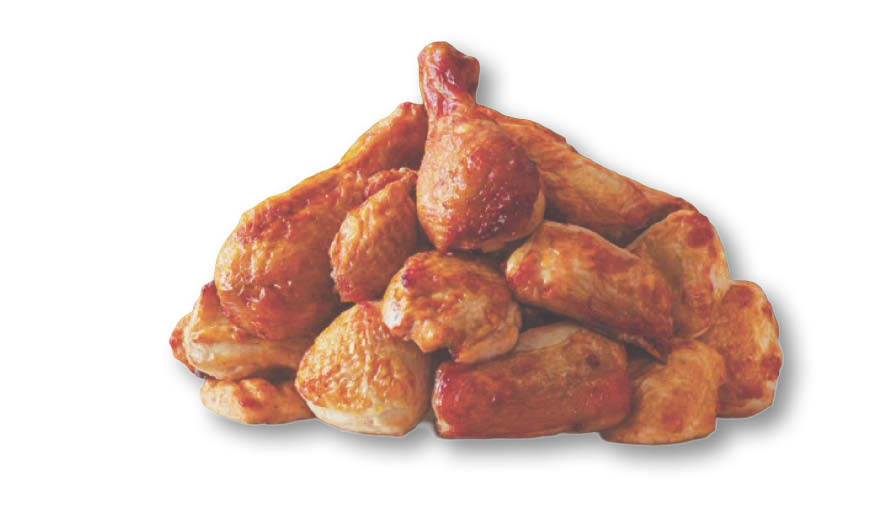
A franchise chicken chain has become the first to reduce portion weights since the government introduced mandatory chicken weight labeling about six months ago, as the industry grapples with a supply crunch triggered by a highly pathogenic avian influenza outbreak.
G&Food, the operator of the Goobne Chicken franchise, decided to reduce the pre-cooked weights of its boneless drumstick, wingette and whole drumstick menus starting June 1, according to industry sources. The boneless drumstick menu dropped from 800 grams to 700 grams. The wingette was reduced from at least 930 grams to 850 grams, and the whole drumstick from at least 905 grams to 820 grams.
"We maintain our principle of using only 100 percent domestically sourced chicken drumstick meat," G&Food said. "To avoid mixing in imported ingredients or other cuts and to uphold our existing quality standards, we chose to adjust the operating criteria for some menus."
The immediate trigger was a highly pathogenic avian influenza outbreak last winter that dealt a severe blow to broiler farms. The resulting supply disruptions have significantly increased raw material costs for the company's headquarters this year. Logistics costs have also risen due to the ongoing conflict in the Middle East.
Those pressures fueled widespread speculation about price increases across the franchise chicken industry, but the sector's "Big Three" — BBQ, bhc and Kyochon — led a price freeze. Headquarters absorbed the added burden, a move widely interpreted as falling in line with the government's emphasis on price stability.
Against that backdrop, Goobne Chicken's weight reduction is being viewed as a form of shrinkflation — a practice more common during prolonged periods of high inflation, in which a product's price is held steady while its size or weight is cut. Kyochon Chicken drew criticism last September for trimming the weight of some menu items but reversed course after public backlash. The Ministry of Food and Drug Safety then introduced mandatory chicken weight labeling starting in December last year.
Some in the industry see the decision as a calculated risk. "It is difficult to raise consumer prices, and raising the supply price would increase the burden on franchisees," one industry official said. "It appears the company chose weight reduction as a last resort to protect its margins." Another official noted that boneless and partial cuts require more processing than whole broilers, making them more expensive and harder to source. "Supply difficulties would have been even greater for those cuts," the official said.
Other major franchise chicken chains say they are not considering weight reductions, though they are worried about falling profitability as the supply crunch drags on. The industry expects chicken supply to normalize only gradually after the peak summer season. July — which includes the first and second of the traditional "sambok" hot-weather days — is seen as the critical period.
Chicken prices have been rising again of late. According to the Korea Agro-Fisheries and Food Trade Corporation, the domestic broiler price reached 6,657 won ($4.80) per kilogram as of June 1, up about 17 percent from the same period last year. Broiler prices surpassed 6,000 won in mid-February this year, hit 6,772 won in mid-April, and have since fluctuated around the 6,500-won mark.
soho0902@heraldcorp.com