Major petrochemical companies expected to return to profit in Q2
Middle East war boosts product margins through lagging effect
Second-half earnings seen weakening as reverse-lagging kicks in
Some analysts say reverse-lagging has already begun
Firms plan to accelerate shift to high-value products
![An aerial view of LG Chem's naphtha cracking center in Yeosu. [LG Chem]](https://wimg.heraldcorp.com/news/cms/2026/06/05/news-p.v1.20260316.af86062058114cc583cb797b092f9d10_P1.png)
South Korea's major petrochemical companies, which posted surprise earnings in the first quarter, face an uncertain road ahead starting in the second quarter. A positive lagging effect — the time gap between raw material purchases and product sales — makes a return to profit likely, but concerns are mounting that inventory valuation losses from stabilizing oil prices could push some firms back into the red.
With Chinese oversupply still weighing on the sector, domestic petrochemical companies are expected to accelerate a shift toward high-value product portfolios to defend their earnings.
According to securities industry estimates, LG Chem's petrochemical division is forecast to post an operating profit of 307 billion won (about $201 million) in the second quarter — a swing to profit from a loss of 90 billion won in the same period last year. Lotte Chemical (86.6 billion won) and Hanwha Solutions' chemical division (93.3 billion won) are also expected to exit the red in the same period.
The likely driver of that profitability is the lagging effect: raw materials purchased at lower prices in the past are now being sold as finished products at higher prices, widening margins in the wake of the Middle East war. According to the Ministry of Trade, Industry and Energy, the average price of ethylene — a basic petrochemical feedstock — reached $1,378 per ton in April, more than double the mid-$600 range seen in February.
The upswing is expected to reverse in the second half of the year. Crude-based raw material prices, which surged following the outbreak of the Middle East war, are now entering a stabilization phase, raising the likelihood that a reverse-lagging effect will take hold. Some analysts say the reversal has already begun.
Ethylene prices, which had approached $1,400 per ton, fell to just above $1,000 per ton last month. In response to the price decline, some brokerages now expect Hanwha Solutions' chemical division and others to post a loss in the second quarter.
Persistent oversupply risk from China adds another headwind. Industry observers expect China's petrochemical capacity expansion to continue at least through 2028.
To insulate themselves from external risks, petrochemical companies plan to speed up their shift toward high-value product portfolios. The strategy is to expand their specialty — or high-value-added — product businesses, where China struggles to achieve mass production, and build a more resilient earnings base.
![Raw material storage silos at Lotte Engineering Plastics' Yulchon factory. [Lotte Chemical]](https://wimg.heraldcorp.com/news/cms/2026/06/05/news-p.v1.20260424.5998b8da5bb84cd5948ea5790d86b622_P1.jpg)
LG Chem is expanding its electronic materials business, with plans to double the segment from its current 1 trillion won scale to 2 trillion won by 2030. Electronic materials command high margins thanks to steep technology barriers to entry and the long-term partnerships they tend to secure. To improve product quality, LG Chem has consolidated and newly established a dedicated advanced research and development unit under its Advanced Materials Research Institute.
Lotte Chemical plans to complete construction of South Korea's largest compounding factory in the second half of this year. Compounding involves blending basic petrochemical products with various additives in optimized combinations to enhance performance. The new facility is designed to mass-produce super engineering plastics for applications including robots. Hanwha Solutions, meanwhile, is broadening its lineup of high-value cable materials.
![An aerial view of Hanwha Solutions' cable materials factory in Yeosu, South Jeolla Province. [Hanwha Solutions]](https://wimg.heraldcorp.com/news/cms/2026/06/05/news-p.v1.20260605.2649e327be24461ba510cc73e86b131f_P2.jpg)
Analysts say that for petrochemical companies to achieve stable earnings, the government-led restructuring of naphtha cracking centers must gain momentum. With no clear end in sight for Chinese oversupply, South Korean petrochemical firms need to reduce their dependence on basic petrochemical products to survive, the argument goes.
The government-led NCC restructuring effort, which began last year, has lost steam in the wake of a naphtha shortage triggered by the Middle East war. The government had declared as recently as late last year that it would wrap up the NCC restructuring within the first quarter of this year, but discussions are still ongoing at industrial complexes in Ulsan and parts of Yeosu.

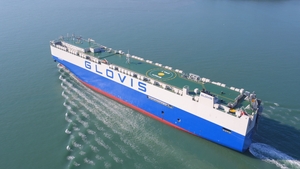
HD Hyundai Heavy and HD Korea Shipbuilding, both shipbuilding affiliates of HD Hyundai, received preliminary approval from Lloyd's Register for the concept design of a small modular reactor-powered vessel at Posidonia 2026, a maritime exhibition held in Athens, Greece.
yeongdai@heraldcorp.com