Democrats win 19 of 31 seats, up from 9; PPP drops from 22 to 12
Democrats retake Gimpo; PPP defends Yongin and Seongnam
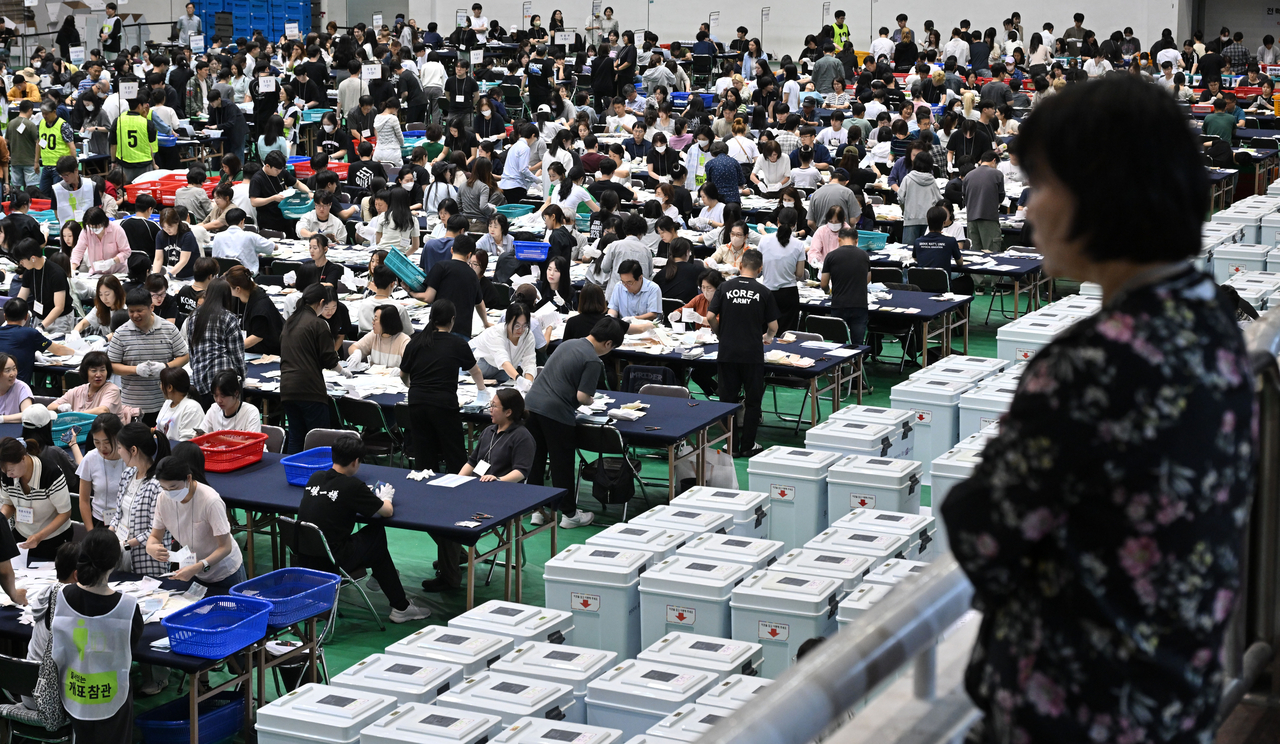
The Democratic Party of Korea won 19 of 31 municipal and county chief seats in Gyeonggi Province — South Korea's largest provincial government with a population of more than 14 million — taking a clear numerical lead. Yet the People Power Party held symbolically important cities including Yongin and Seongnam, preventing the outcome from becoming a one-sided rout.
According to the National Election Commission's final count Thursday, the Democratic Party won in Suwon, Goyang, Hwaseong, Bucheon, Namyangju, Anyang, Siheung, Paju, Gimpo and 10 other cities, while the PPP claimed 12 seats including Yongin, Seongnam, Ansan, Hanam, Gwacheon, Uiwang, Pocheon, Gapyeong and Yeoncheon. Compared with the 2022 local elections — when the Democratic Party won just nine seats and the PPP took 22 — the Democrats gained 10 seats and the PPP lost 10.
While the Democrats succeeded in flipping the overall seat count, analysts said the result fell short of the landslide the party had anticipated going into election day. The PPP, for its part, maintained its presence by defending eastern and northern Gyeonggi as well as several key urban centers.
Political observers noted that one defining feature of this Gyeonggi race was that voters at the provincial and municipal levels did not move in lockstep. The divergence suggests that voters weighed local issues, assessments of incumbents and candidate quality alongside broader partisan considerations.
Gimpo drew particular attention. Democratic candidate Lee Ki-hyung defeated incumbent PPP Mayor Kim Byeong-su, reclaiming a city the party had lost in the previous election. Gimpo had been a flashpoint throughout the campaign over issues including a proposal to absorb the city into Seoul, chronic overcrowding on the Gimpo Gold Line and discussions over the GTX-D rail extension. Voters appeared to opt for a change in city leadership to accelerate solutions to those local concerns.
In Yongin, by contrast, incumbent PPP Mayor Lee Sang-il won re-election, securing what analysts described as a critical southern anchor for the party. Holding Yongin while the Democrats swept most other major cities carried significant symbolic weight for the PPP.
Yongin is more than a large city — it sits at the center of industrial and development policy for southern Gyeonggi. Major projects are concentrated there, including a national semiconductor industrial complex, Platform City and road and rail network expansions. Voters appear to have prioritized administrative continuity and development momentum over party affiliation.
Seongnam was another race that came to define the Gyeonggi results. Incumbent PPP Mayor Shin Sang-jin defeated Democratic candidate Kim Byeong-wook to win re-election.
Seongnam has long been regarded as symbolic territory for the Democratic camp — home turf, in particular, of President Lee Jae Myung. The PPP's back-to-back victories there have led analysts to conclude that the city can no longer be considered a safe Democratic stronghold.
Looking at the broader picture, the Democrats swept a belt of southwestern and central cities — Suwon, Hwaseong, Bucheon, Anyang, Gwangmyeong, Siheung, Pyeongtaek and Paju among them.
The PPP, meanwhile, held the southeastern corridor of cities with strong Seoul access — Yongin, Seongnam, Hanam, Gwacheon and Uiwang — as well as the northeastern and outer fringe of the province, including Gapyeong, Yeoncheon, Yangpyeong, Pocheon and Yeoju.
For the Democrats, winning 19 seats is a solid number on its face, but failing to recapture politically resonant cities such as Seongnam and Yongin remains unfinished business. Notably, in Ansan — a city with a traditionally progressive lean — incumbent PPP Mayor Lee Min-geun defeated Democratic candidate Cheon Yeong-mi to win re-election.
"The PPP lost on the overall tally, but by defending key strongholds including Yongin and Seongnam it proved it can still compete in the greater Seoul area — and that is enough to say it avoided a total defeat," a political insider said.
rimsclub@heraldcorp.com