Facing a $2.3 billion deficit, the university system cut faculty and departments while spending 25 billion won ($16.9 million) on OpenAI — leaving students and professors asking who the education is really for
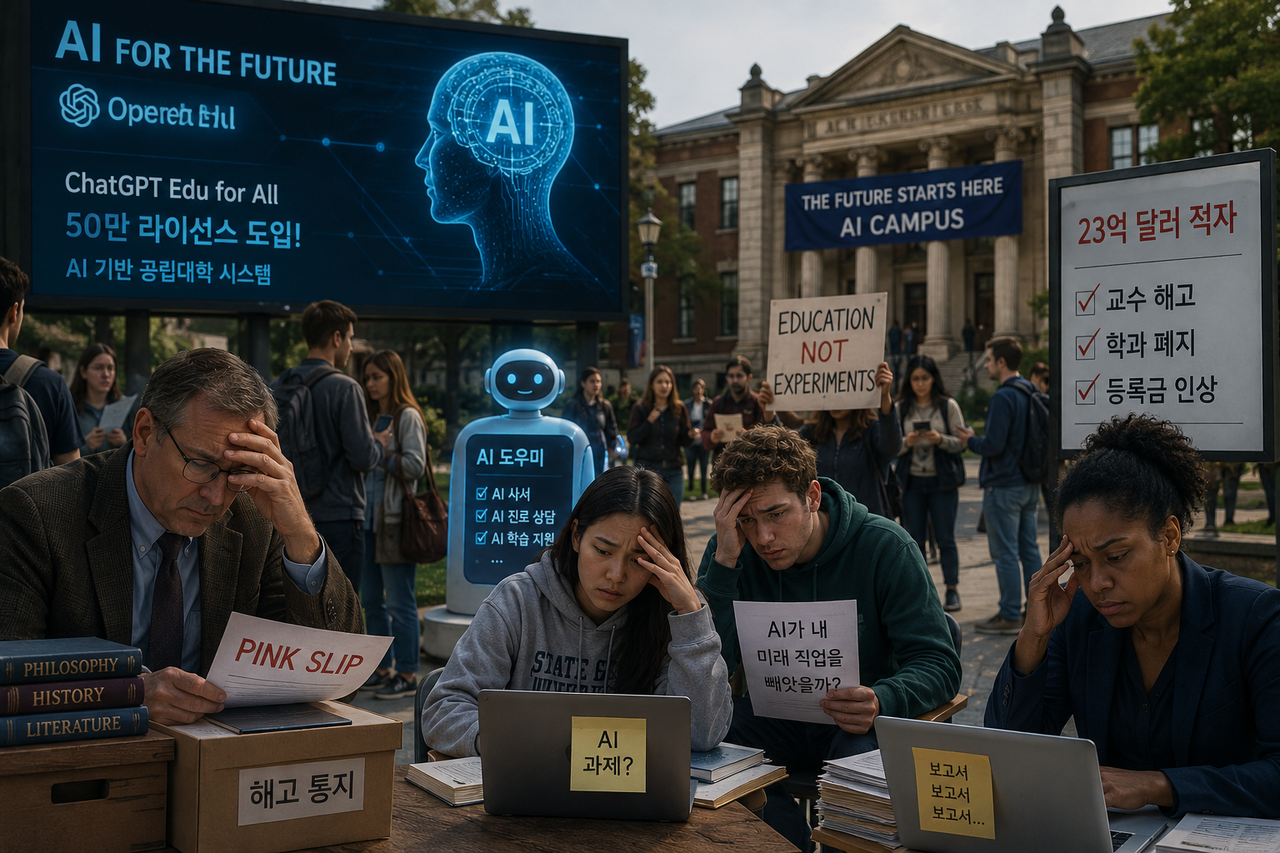
The California State University system, the largest public university system in the United States, launched what it billed as the world's biggest university AI adoption project in partnership with OpenAI — but just a year in, the initiative has sparked deep conflict among faculty, students and administrators.
The New York Times reported June 2 that while CSU positioned AI as the solution to the future of education, the university's own community has been left confused about what that education is actually for.
Last year, CSU signed a $16.9 million (about 25 billion won) contract with OpenAI to provide 500,000 ChatGPT Edu licenses to students, faculty and staff across the system — at the time, the largest single-institution ChatGPT deployment in the world.
The university declared it would use the partnership to build the first AI-integrated public university system in the United States, spanning all 22 of its campuses.
San Jose State University has been among the most aggressive adopters of the policy. Incoming students receive a welcome message from the university president rendered as an AI avatar. The school has rolled out an AI librarian, an AI center and an AI career counseling service, and even used AI agents to help run its commencement ceremony.
The president refers to himself as the university's CEO. "Universities must innovate like businesses in a rapidly changing environment," he said, adding that the school is building "a new model that integrates AI into education, research and student career development."
California is home to a concentration of global technology giants — Nvidia, Google, Microsoft, Adobe and IBM among them. Gov. Gavin Newsom has also been an active supporter of expanding AI education.
The state government plans to cultivate a pipeline of future AI talent by expanding AI education programs for high school, community college and state university students.
The problem, however, is that no one can accurately predict what the AI-transformed labor market will actually look like.
While the university promotes the initiative as preparing students for future jobs, faculty warn that AI could erode students' critical thinking and writing skills.
The controversy has been amplified by a simultaneous fiscal crisis. CSU is grappling with a $2.3 billion deficit that has forced it to dismiss tenured professors, shut down some departments and raise tuition.
Against that backdrop, the faculty union has pushed back sharply against the decision to invest tens of billions of won in OpenAI.
Professors have organized a petition drive opposing renewal of the OpenAI contract. About 4,000 students and faculty members have signed it so far.
Student reactions are mixed. Some have embraced AI as a new opportunity — computer science majors, in particular, have used it to land internships or launch startups.

Others, however, worry that AI could threaten their future job prospects.
"The school says it has no money, yet it's paying tens of billions of won to an AI company," said one political science student, who also criticized the university for excluding students and faculty from the decision-making process.
Despite the backlash, university administrators recently extended their OpenAI contract for an additional $13 million. The university also plans to let graduates continue using ChatGPT for a year after receiving their degrees.
The New York Times said the dispute has grown beyond a debate over whether to adopt AI, expanding into a broader argument about the role of public education and the fundamental purpose of a university.
mokiya@heraldcorp.com