Democratic Party initially favored, but a string of surprises tightened the race; opposition targeted the ruling party with a 'fabricated indictment' special prosecutor push; the Seosomun overpass collapse rattled voters on safety
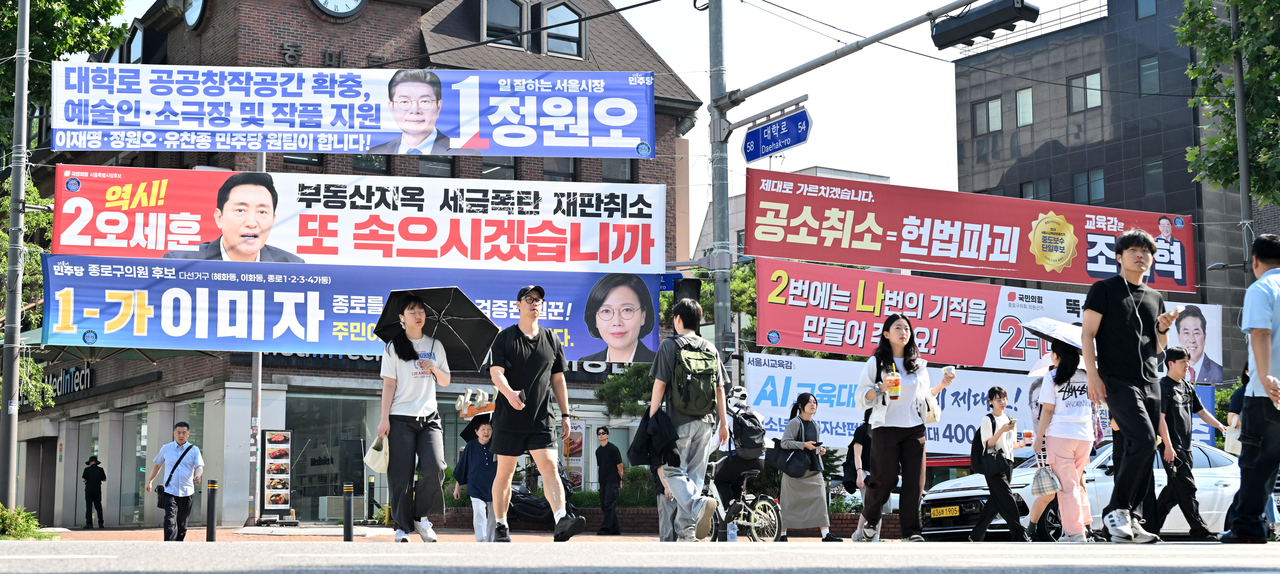
With the June 3 local elections one day away, the ruling and opposition parties are making a final push for votes. The Democratic Party of Korea had been widely expected to dominate, but a succession of controversies, accidents and unexpected developments has produced tighter-than-anticipated races in some areas, political observers say.
Jang Dong-hyeok, the People Power Party's standing election campaign committee chairman, said at the party's central headquarters Monday that "a Kospi of 8,000 is the only shield President Lee Jae Myung and the Democratic Party have to cover up their own misrule," arguing that support for the PPP would contribute to economic recovery and improved livelihoods.
Democratic Party floor leader Han Byung-do struck a different tone at a floor strategy meeting the same day. "There are signs that our economy is moving beyond quantitative growth toward a more solid foundation," he said, calling the election "the starting point for completing national normalization and building a country of great leaps forward where regions can prosper."
The economy was the sharpest point of contention between the two sides. The Democratic Party highlighted the Kospi's climb past the 8,000 mark since the Lee administration took office, framing it as a record of economic achievement. Party leader Jung Chung-rae appealed directly to investors, saying, "If you've been feeling good looking at your brokerage account, please cast your vote for Democratic Party candidate No. 1."
The People Power Party pushed back by pointing to controversy over a proposed universal dividend, instability in the real estate market and high inflation driven by Middle East tensions, pressing the case that voters should deliver a verdict on the government. A senior PPP official said that "despite rising share prices, the economic conditions people actually feel in their daily lives are still far from easy," adding that "as the election draws closer, that public sentiment is finding expression."
A controversy over a so-called "fabricated indictment" special prosecutor act, which surfaced about a month before the election, also emerged as a major variable. The Democratic Party moved to push a special prosecutor targeting alleged irregularities in investigations and indictments during the Yoon Suk Yeol administration, but mounting concern inside and outside the party led it to postpone the bill until after the local elections. The PPP branded the measure a "charge-dropping special prosecutor" bill and kept up its offensive against the ruling party.
Safety became a defining issue in the final stretch of the campaign. A series of accidents — the Seosomun overpass collapse in Seoul, an explosion at Hanwha Aerospace in Daejeon and a toxic gas exposure incident at SK Hynix in Cheongju — prompted both parties to briefly suspend parts of their campaign schedules. How each side handled the crises could sway public opinion, analysts said.
Democratic Party Seoul mayoral candidate Jung Won-o had earlier pledged to "fundamentally overhaul Seoul's safety standards" in response to the Seosomun accident. PPP election headquarters chief Jung Hee-yong criticized President Lee over the Hanwha Aerospace explosion, saying that "barely 30 minutes after the accident was reported, the president was spending his time posting a rebuttal to stock market coverage on his social media."
The two parties also clashed over Starbucks' marketing campaign tied to May 18 — dubbed "Tank Day" — which drew accusations of trivializing the Gwangju Uprising. The dispute escalated into a broader political fight after President Lee raised the possibility of legal action against online communities including Ilbe.
Democratic Party chief spokesperson Kang Jun-hyeon said "the government and the ruling party have not compelled anyone to feel anger or join a boycott," and accused the PPP of "exploiting the perfectly reasonable call to correct a distorted view of history as a tool for political squabbling and electioneering." Jang rebuffed that, saying, "If there was wrongdoing, it should be punished through trial and corrected so it never happens again — but President Lee and the Democratic Party have slapped labels of hatred and discrimination on a company and its executives."
Controversies surrounding individual candidates also ran throughout the campaign. The PPP went on the offensive against Democratic Party Seoul mayoral candidate Jung Won-o, raising allegations of junket-style overseas trips and an assault incident. Ha Jung-woo, the Democratic Party's candidate in the Busan Buk-gap by-election, drew criticism during campaigning for appearing to wipe his hand after a handshake and for addressing a voter as "oppa" — a Korean term used by women toward an older male acquaintance. Woo Hyeong-chan, the Democratic Party's candidate for Yangcheon-gu district chief, bowed in apology after remarks he made to an infant during campaigning sparked a backlash.
The Democratic Party sought to tie PPP candidates to former President Yoon Suk Yeol from the outset of the nomination process, framing some as a "Yoon again" slate. The party zeroed in on the fact that Park Min-sik, the PPP's candidate in the Busan Buk-gap by-election, served as the inaugural minister of Patriots and Veterans under the Yoon administration, and that former lawmaker Lee Yong, running in the Gyeonggi Province Hanam-gap by-election, had served as chief of staff to Yoon during his presidential campaign. In the final stages of candidate selection, former presidential chief of staff Jeong Jin-seok was also mentioned as a potential PPP nominee for the National Assembly by-election in the South Chungcheong constituency of Gongju, Buyeo and Cheongyang.
mp1256@heraldcorp.com