2026 BOK International Conference
Presentation by Prof. Robert M. Townsend of MIT
Bank of Korea's tokenized deposits and CBDC link draw attention

"With its integrated programmable ledger environment, the Bank of Korea is one of the leading innovators. If smart contracts that automatically enforce specific rules become possible, there is a great deal more that can be done."
Robert M. Townsend, a professor at the Massachusetts Institute of Technology, offered that assessment of the Bank of Korea's digital currency experiments Tuesday at the 2026 BOK International Conference, held at the Bank of Korea's annex conference hall in Jung-gu, Seoul. As stablecoins increasingly disrupt the international financial order, he said the Bank of Korea's Han River Project represents a real-world test of future financial infrastructure built on a programmable ledger.
Presenting on the theme of "Stablecoins and Programmable Ledgers," Townsend said blockchain, smart contracts and multilateral algorithms "offer the potential for beneficial integration, not disruption in itself," adding that "technology is evolving ever faster."
Townsend identified cross-border remittances as the most prominent use case for stablecoins. The international remittance market is structured around commercial banks, correspondent banks and the SWIFT network — an arrangement that favors large banks and major currency zones. "Even at the G20 level, the goal is to bring remittance fees down to around 2.6 percent, but in sub-Saharan Africa they still exceed 8 percent in some cases," he said.
Against that backdrop, stablecoins are claiming a growing share of the global remittance market. "About 23 percent of global remittances are now conducted through stablecoins," Townsend said, "and the volume of stablecoin use continues to grow."
He also referenced the "Stablecoin Sandwich" concept put forward by Federal Reserve Governor Christopher Waller — a structure in which value moves from fiat currency to a digital asset and back to fiat currency. The model is frequently cited as a key application of stablecoins for cross-border transactions, given its potential to cut costs and speed up settlement.
"In the United States, the stablecoin market broadly encourages private-sector players," Townsend said. "We are at a fork in the road: do we head toward a market of competing, incompatible stablecoins, or toward a more cooperative one?" he added.
The EU's digital euro was also presented as a comparative case. Townsend said the digital euro is being treated as a strategic priority to protect Europe's banking and monetary systems, with EU member states simultaneously building both near- and long-term infrastructure as they pursue integration.
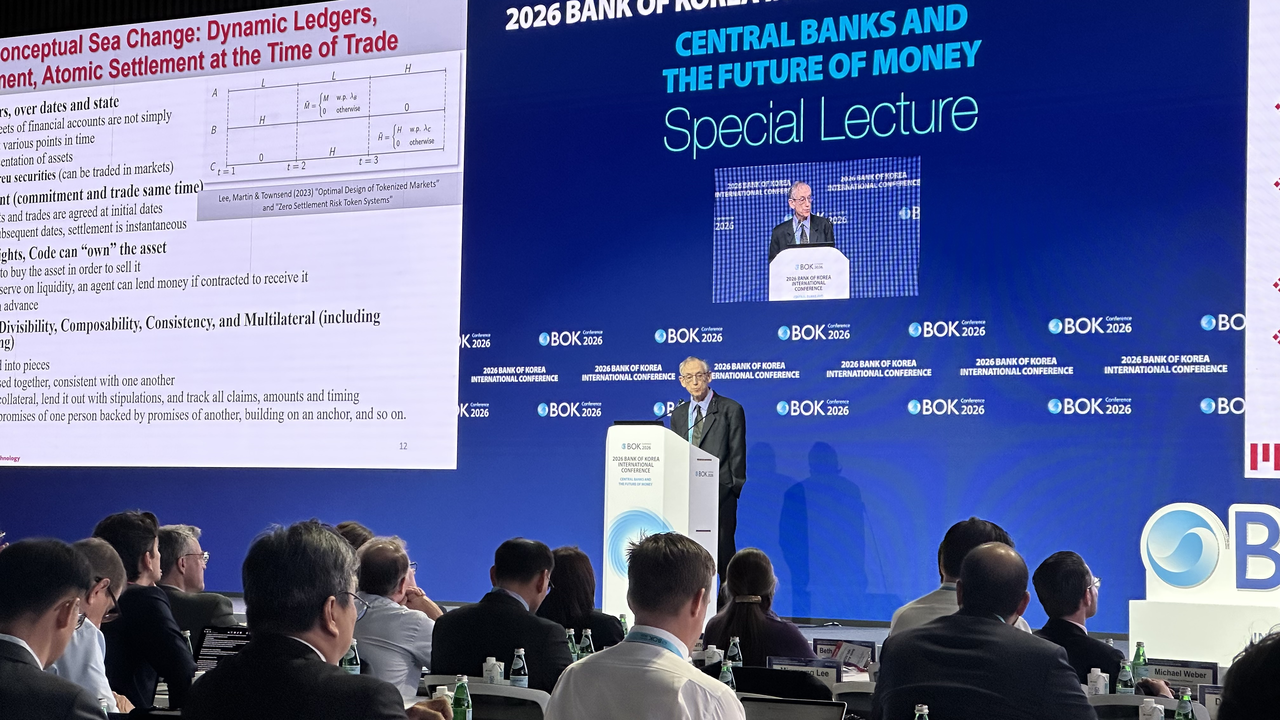
The case that drew Townsend's particular attention was the Bank of Korea's Han River Project. He described it as "a leading programmable digital currency system based on distributed ledger technology," saying it "supports interbank settlement of tokenized deposits and can be extended to digital assets in the future."
A defining feature of the Han River Project is that its wholesale and retail components are connected within the same ledger structure. "Programmability enhances the functionality of payments," Townsend said. "Smart contracts can be used to issue public vouchers for cultural events and youth programs, as well as to subsidize electric vehicle charging infrastructure — all of which have already been tested in real transactions." He added that on-chain settlement of carbon credits and digital ESG bonds are currently under consideration by the Han River team.
Townsend cited a joint project with the Bank for International Settlements as a concrete example of programmable ledger implementation. In a debt-clearing experiment using data from 45,000 Italian companies, he said, liquidity equivalent to just 18 percent of total outstanding debt was sufficient to clear 50 percent of that debt.
He described the result as "maximum utilization from minimum liquidity." While conventional approaches such as central clearing and netting can carry risk or require large amounts of collateral, algorithm-based clearing can serve as a more efficient alternative, he said.
The coexistence of legacy financial infrastructure and tokenized distributed ledger infrastructure was also raised as a key challenge. With both systems operating in parallel, Townsend said, institutions must decide "not only what to put on the blockchain, but how to make it interoperable with existing systems."

kyoung@heraldcorp.com