Bank of Korea holds BOK International Conference; governor holds policy dialogue with ECB executive board member; restrictive monetary policy stance signaled again
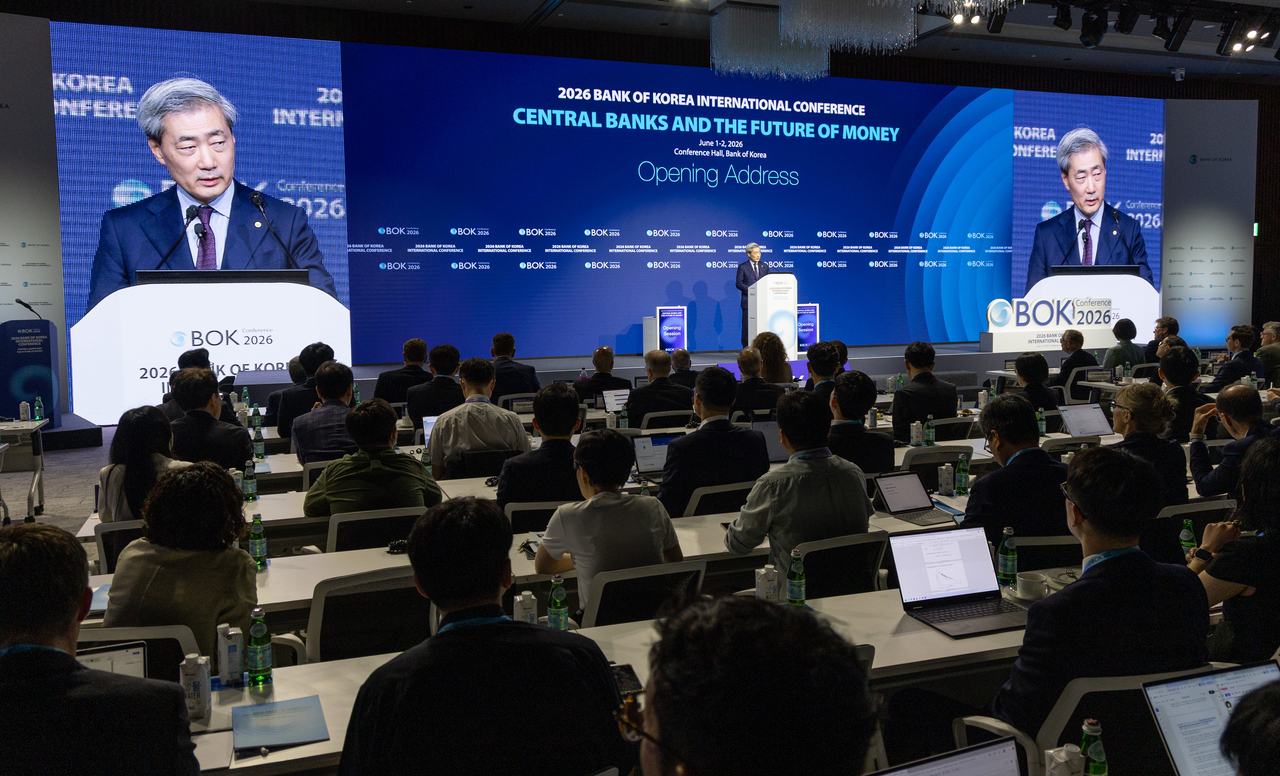
Bank of Korea Gov. Shin Hyun-song said Monday that all key indicators are pointing in the same direction, giving the central bank greater room to maneuver in conducting monetary policy.
Speaking at the 2026 BOK International Conference held at the Bank of Korea's annex building, Shin held a policy dialogue with Isabel Schnabel, a member of the European Central Bank's executive board. He noted that South Korea, like the euro area, is sensitive to energy price shocks, but said the country's economic fundamentals remain strong. "Growth in Korea is robust. In particular, first-quarter GDP rose 3.6 percent year-on-year, while GDI grew 12.3 percent — that is an exceptionally high figure," he said.
Shin said that while rising oil prices typically worsen the terms of trade and cause GDI growth to lag behind GDP, that dynamic did not play out this time. "The gains from the semiconductor sector outweighed the impact of higher energy prices," he said, adding that the result was driven by strong exports.
Shin said the conditions for a restrictive monetary policy stance are now in place. "There are fewer obstacles to adjusting monetary policy in relation to inflation," he said. "The difficult part of conducting monetary policy is when factors pull in opposite directions, but the economy is strong and the output gap — real GDP minus potential GDP — looks set to turn positive next year." He added that when housing prices, household debt and the exchange rate are all taken into account, every indicator points in the same direction. "We have considerably more room to conduct monetary policy," he said.
The Bank of Korea is holding the two-day 2026 BOK International Conference starting Monday under the theme "Central Banks and the Future of Money." The event brings together the latest research and policy cases on topics including the link between financial stability and monetary policy, digital currency and payment innovation, communication strategy, the historical evolution of central banks, and AI technology innovation.
In a keynote address titled "Central Banks and the Future of Money," Schnabel said stablecoins promise efficiency gains in the payments space, but argued that much of the benefit stems from the underlying technology rather than the instrument itself. "The right response is to keep pace with technological innovation and define a framework within which private innovation can flourish," she said.
She added that the goal should be to ensure new forms of private money — such as stablecoins and tokenized deposits — complement rather than crowd out public money, with public money continuing to serve as the anchor settlement asset. "Whether stablecoins will carve out a place within the financial system the way money market funds did 50 years ago, or whether other innovations such as tokenized deposits will prove to be more promising alternatives, remains to be seen," she said.
In a subsequent session, Tobias Adrian, financial counselor and director of the IMF's Monetary and Capital Markets Department, presented on "Financial Vulnerabilities and Monetary Policy." He said changes in financial conditions affect not only average economic trends but also the risk of extreme downturns. "Even if financial stability is not a direct policy objective of central banks, financial vulnerabilities must be factored into the conduct of monetary policy in order to reduce medium- to long-term volatility in prices and the output gap," he said.
Markus Brunnermeier, a professor at Princeton University, presented on "The Trilemma of Payments, Credit and Digital Currency," arguing that digital currency systems cannot simultaneously achieve all three core objectives: efficient payments, efficient credit supply and privacy protection. He recommended that policymakers fully account for these trade-offs when designing frameworks for central bank digital currencies and other digital money initiatives.
Michael Weber, a professor at Purdue University and ESMT Berlin, addressed the issue of public perceptions of political bias at the Federal Reserve.
kimstar@heraldcorp.com
forest@heraldcorp.com