
Campaign vehicles illegally parked in school zones and other restricted areas; police and district offices hesitant to act over fears of political bias; experts call for clear national guidelines rather than leaving enforcement to individual civil servants
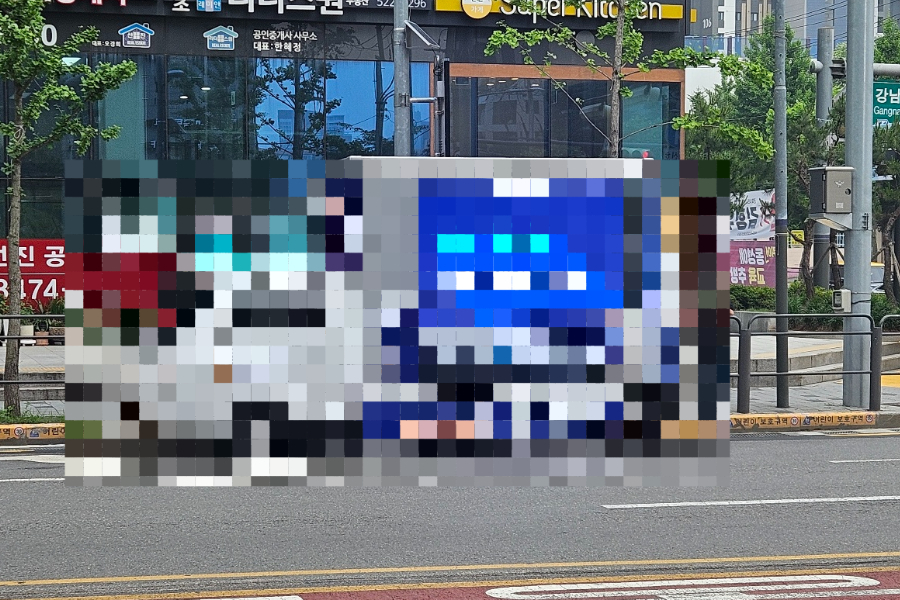
Illegal parking by campaign vehicles — a recurring problem every election season — is drawing fresh complaints from Seoul residents. Vehicles have been spotted parked not only in restricted zones but openly inside school zones, snarling traffic for both drivers and pedestrians. Enforcement remains elusive: civil servants who attempt to issue tickets must absorb any backlash from candidates' camps on their own.
Experts say clear institutional guidelines on enforcing traffic rules against campaign vehicles are essential before election-season traffic disruption can be resolved.
Illegal campaign parking backs up traffic
At around 9:10 a.m. Monday at the Yeoksam Station intersection in Gangnam-gu, Seoul — a busy junction during the morning commute — a campaign vehicle sat unattended on a yellow-dashed stretch of road where only momentary stops are permitted. The vehicle did not move for more than 20 minutes.
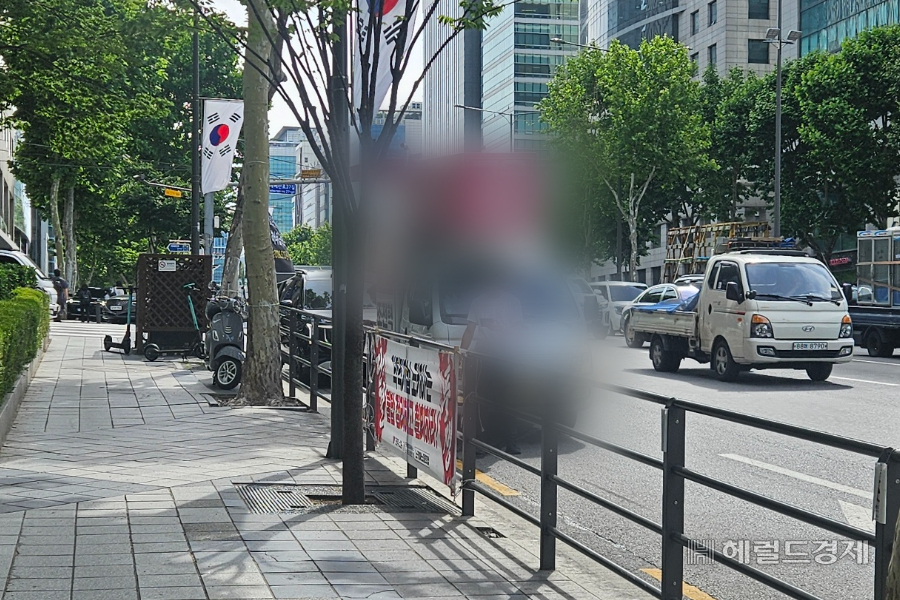
The illegally parked vehicle caused a traffic backup. It blocked the space needed for right turns, forcing a bus to wait for more than 20 cars to pass before it could merge into the third lane.
Park I-su, 27, who was passing by, said the vehicles create blind spots at crosswalks and intersections. "When a campaign vehicle stops at a crosswalk or in a corner of an intersection, you can't see whether cars are coming when you try to cross," she said. "I don't think campaign vehicles should get a free pass."
Seo Seung-hye, 34, said campaign vehicles parked along the roadside for long stretches during rush hour are a constant nuisance. "Particularly near intersections, they block your line of sight so you can barely see the crosswalk," she said.
"Every election season the roads feel even more congested," she added. "Add the loudspeakers on top of that and the fatigue really builds up. I wish they would take citizens' inconvenience into account."
Illegal parking in school zones was also observed. At around 7 a.m. on May 29 in front of Seoi Elementary School in Seocho-gu, Seoul, a campaign vehicle sat with its hazard lights on inside a school zone intersection as the crew prepared for campaigning.
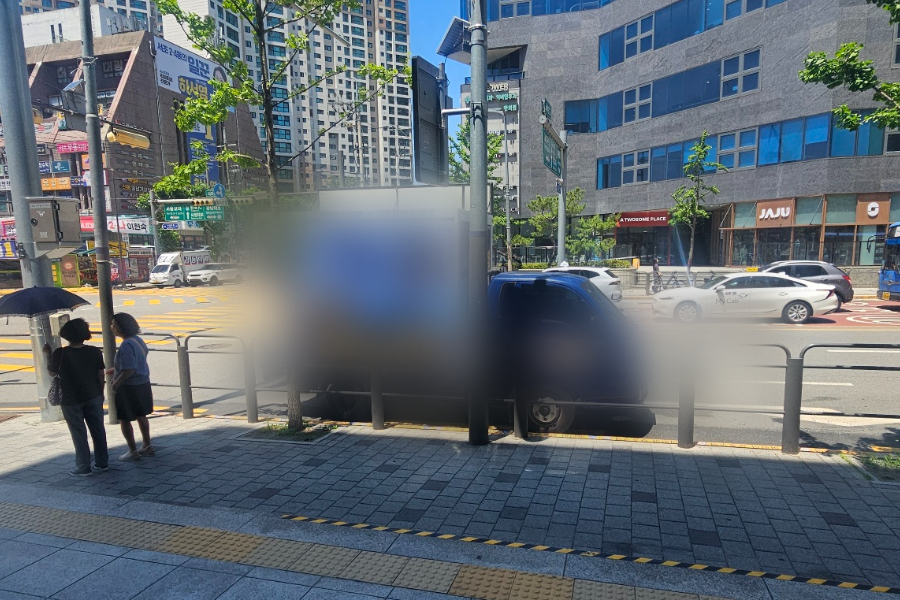
The spot where the vehicle was parked falls within a school zone, where both stopping and parking are prohibited under the Road Traffic Act. A person affiliated with the campaign who was nearby said the vehicle did not leave until after 9 a.m. — meaning it had been parked in the school zone for more than two hours.
Illegal parking by campaign vehicles was again visible at the same location around 12:20 p.m., a busy midday period. Drivers turning right had to swerve around the campaign vehicle, and when a bus attempted to pass, it briefly blocked the road.
Motorists voiced frustration. A motorcyclist passing through said, "The moment you turn right, there's a truck right there — your view is completely blocked."
When a reporter asked the campaign vehicle's driver whether parking in a school zone was permitted, the driver said, "I understood it was fine during the election period." Asked again whether stopping inside a school zone was actually allowed, the driver said, "I'll move it," and drove off. The exchange suggested that even the driver was unaware of the parking rules that apply to campaign vehicles.
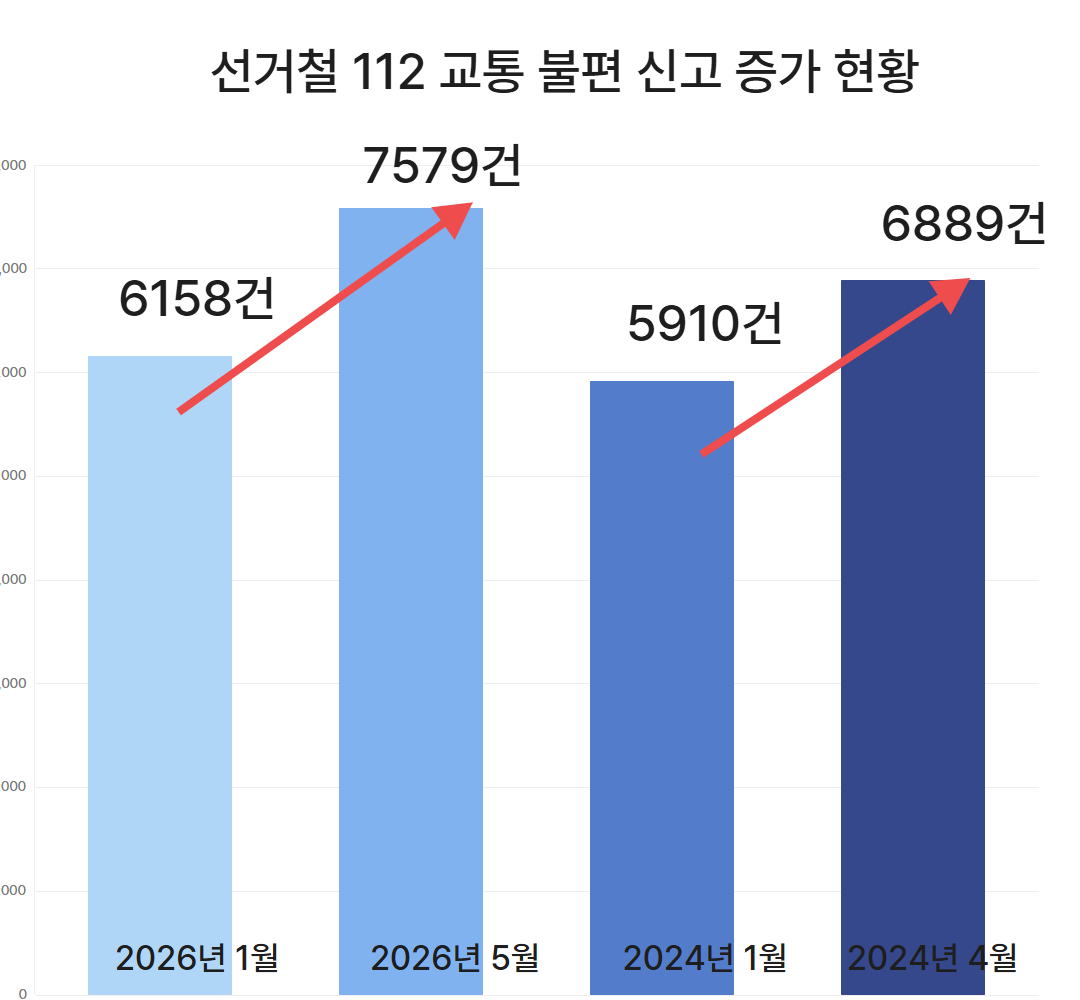
The traffic disruptions that recur every election season are translating into a surge in formal complaints and police calls. During the official campaigning period from May 21 through May 29, Gangnam-gu and Seocho-gu together received 24 complaints about illegally parked campaign vehicles — nine and 15, respectively — averaging about 2.7 per day.
Police emergency calls related to traffic disruptions have also spiked each election cycle. Seoul recorded 7,579 traffic-related complaints in May through May 29, up about 23 percent from 6,158 in January.
A similar pattern emerged during the April 2024 general election. Traffic complaints in Seoul stood at 5,910 in January 2024 before climbing roughly 16 percent to 6,889 in April, when the election was held.
Candidates' camps push back on tickets, leaving enforcers reluctant to act
Police officers and district office civil servants empowered to enforce parking rules said they are reluctant to act against campaign vehicles. One police official said the fear of political fallout is significant. "If we ticket a vehicle from one party, complaints come in asking why we didn't ticket vehicles from other parties," the official said.
"We'd like it if they just moved when officers asked them to on the scene, but the conversations drag on," the official added. "Unlike ordinary cases, we have to argue the merits back and forth, which makes enforcement difficult."
District offices face the same problem. One district office official said campaign vehicles should be held to the same standard as ordinary vehicles, but acknowledged the reality is more complicated. "When we issue a fine, the candidate's camp protests, so there's real pressure not to enforce aggressively," the official said. "It puts us in an awkward position."
Experts said clear enforcement guidelines are needed to ease election-season traffic disruptions. Kim Do-woo, a professor in the police science department at Kyungnam University, said the current situation pits the enforcement mandate under the Road Traffic Act against the legal protection of campaigning under election law, leaving frontline officers without a firm basis for action. "If election authorities or relevant legislation explicitly regulated illegal parking by campaign vehicles, the burden on officers in the field would ease considerably," he said.
Kim added that the problem could be largely resolved if the National Election Commission explicitly classified such conduct as subject to restriction and management under election law. "Once the legal basis for enforcement is clear, police will have no reason to avoid acting," he said.
Yeom Geon-ung, a professor in the police and fire administration department at U1 University, said frontline officers feel exposed because ticketing a specific candidate's vehicle can trigger accusations that police interfered in the election or favored one side. "This should not be left to the judgment of individual officers on the ground," he said. "The Korean National Police Agency needs to issue clear, agency-level guidelines."
20ki@heraldcorp.com




