School Violence Survival Game, Part 1 — Prologue
[Editorial note]
A punitive crackdown on school violence has turned classrooms into a ruthless survival game. As even minor disputes are automatically referred to school violence deliberation committees, caseloads have exploded — yet the most common outcome is a finding of "not school violence," leaving classrooms stripped of any capacity for self-correction. Caught in a proxy legal war waged by adults desperate to protect their children's college admissions records, students have abandoned apology and reconciliation in favor of collecting evidence against each other. This series examines the structural contradictions of a school violence regime that has lost sight of victim protection and sunk into judicialization — told through four conflicting perspectives: parents, lawyers, teachers and students.
05
2026-06-01 08:35:28
N
Y
![A student struggling under the school violence system. [Image generated with ChatGPT]](https://wimg.heraldcorp.com/news/cms/2026/06/11/news-p.v1.20260610.54f9a57aaf56476db022e01c3726ee45_P1.png)
By Kim Yong-jae, The Herald Business
"Even when friends want to make up, parents call a lawyer first. They say you can't just take it — you have to file a counter-complaint no matter what."
The word "sorry" has long since disappeared from South Korean classrooms.
In its place: lawyers' business cards and the School Violence Deliberation Committee. A zero-tolerance approach and tougher college admissions penalties, introduced to stamp out school violence, have paradoxically pushed classrooms into an every-child-for-themselves survival game — that is the reality of South Korean schools in 2026.
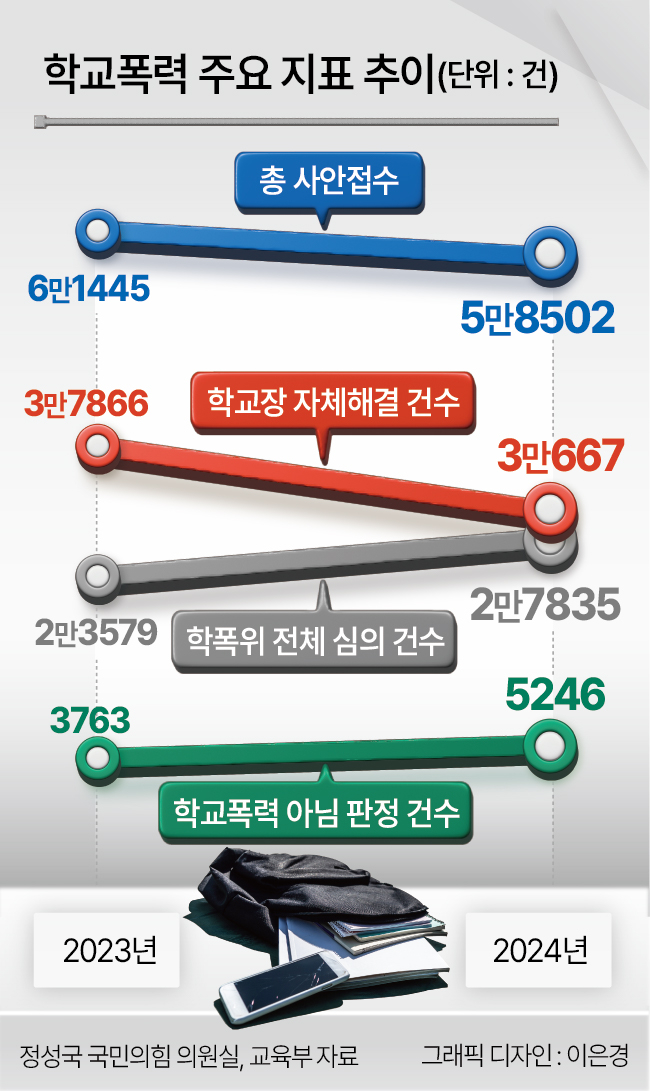
The numbers bear this out. According to data on school violence trends over the past four years submitted to the Ministry of Education by the office of lawmaker Jeong Seong-guk, reported school violence cases surged from 44,444 in 2021 to 58,502 in 2024.
Particularly striking: of the 30,667 cases brought before school violence deliberation committees in 2024, 5,464 — or 17.8 percent — involved counter-complaints, with students responding to accusations by filing their own.
As indiscriminate legal skirmishing spread, cases that went through the full deliberation process only to be ruled "not school violence" more than tripled, rising from 1,669 in 2021 to 5,246 in 2024.
While administrative resources are consumed by mountains of paperwork, the students who actually need protection are being left behind — 8,444 cases received no action at all.
The deeper problem is that the blind spots built into the system have merged with adult ambition to spawn a sprawling school violence industry. Because a school violence record can cost a student points in both regular and early college admissions, parents willingly spend millions — sometimes tens of millions — of won on law firms to protect their children's school records.
Lawyers routinely advise clients to file counter-complaints as a standard tactic to get rulings overturned or drag out proceedings. Teachers, worn down by child abuse complaints and relentless hostile inquiries, have given up mediating disputes and been reduced to procedural guides who mechanically forward cases to district education offices.
Caught in this proxy legal war, peer relationships have become battlegrounds for gathering evidence that could surface at any moment. Instead of reflecting on their mistakes, students are learning to evade legal liability; instead of learning to reconcile, they have become adversaries collecting each other's weaknesses.
This series cross-examines the structural contradictions of a school violence response system that has lost its capacity for educational resolution and sunk into judicialization — through the four conflicting perspectives of parents, lawyers, teachers and students. The goal is to expose the true face of a broken classroom and explore where a path toward genuine relationship repair, beyond punishment, might lie.
brunch@heraldcorp.com