
Eight companies signed MOUs on May 29; life-integrated AI and digital technology pilots to roll out from June — covering foreign-language interpretation at service counters, hologram guides, electric wheelchair accident detection and smart power management
[The Herald Business = Senior Reporter Park Jong-il] Gangnam-gu (District Mayor Cho Sung-myung) will launch a full-scale pilot program starting this month, deploying AI and digital technology across district service counters, community centers, bus stops, welfare facilities and the Yangjae Stream area.
The initiative aims to test in real-world settings how technology can change residents' daily lives — from foreign nationals receiving real-time translation assistance at service counters, to visitors navigating district offices with hologram guides, to sensors automatically detecting electric wheelchair accidents before staff can respond.
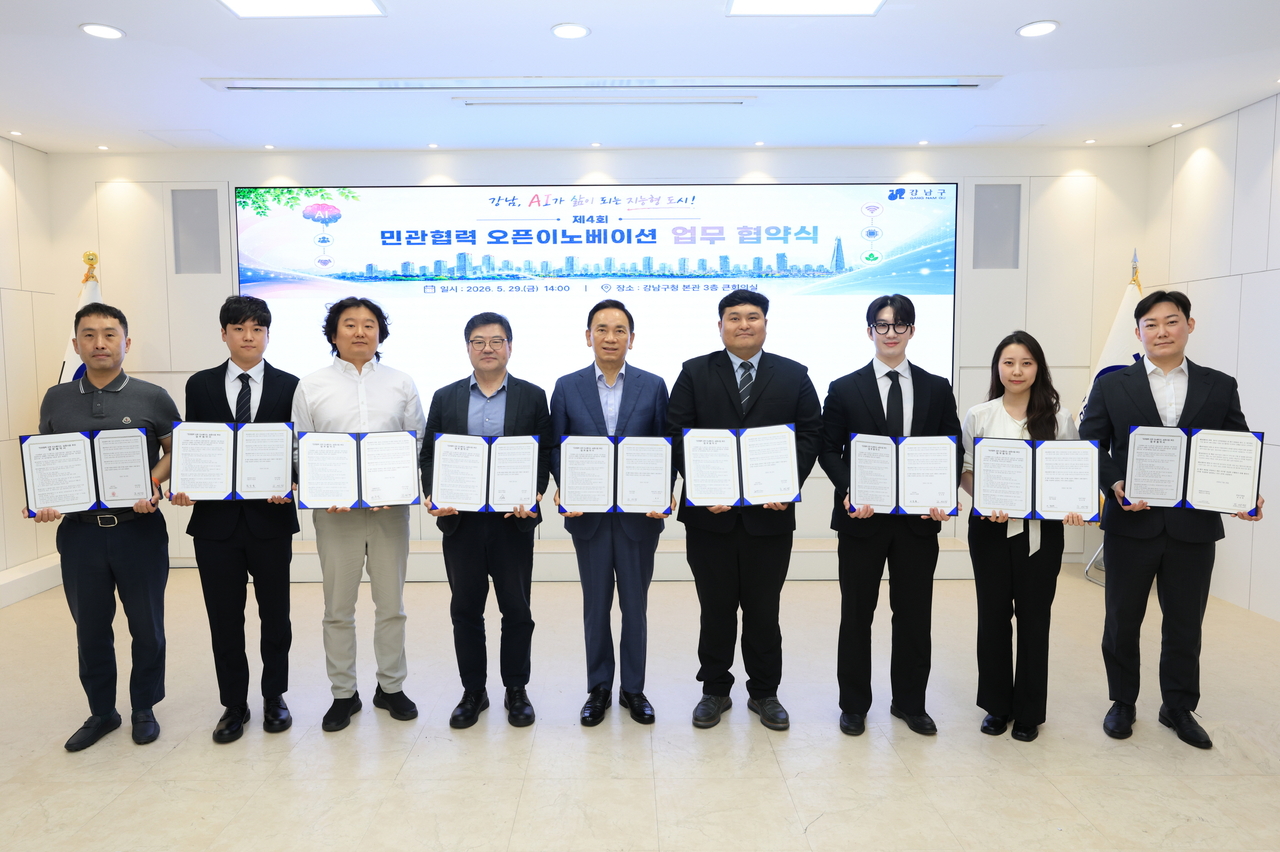
Gangnam-gu selected eight companies through its fourth "Gangnam, AI That Becomes Life — Intelligent City!" public-private open innovation program and signed MOUs with all eight firms on May 29.
Five companies — Widds, Rainbow Company, Zero Labs Korea, Byeolddareo Gaja and BIC&S — are participating under a subsidy-support model, while three others — Infera, Filernier and Preventer — will receive pilot venue access only. The district finalized the participating companies following a recruitment and evaluation process that began in February.
The pilot program focuses on delivering tangible improvements to residents' daily lives across multiple sectors, including public administration, civil services, transportation, welfare, safety, energy and the environment.
At service counters, transparent OLED panels will replace conventional partitions, turning them into real-time communication screens. When a resident or staff member speaks, the words appear as text on the shared display and can be instantly translated into foreign languages, allowing both parties to follow the same screen during their conversation. The first-floor lobby of the district office will also feature an AI hologram guide to direct visitors to the right department and walk them through civil service procedures, with multilingual voice support for foreign visitors.
At neighborhood community centers, a generative AI-powered work assistant will support resident registration and integrated civil service tasks. The AI will learn from extensive manuals and Q&A materials so staff can retrieve the information they need on the spot, improving both the speed and accuracy of service processing.
AI voice-recognition kiosks will be installed at smart rest shelters across the district, allowing elderly residents, people with visual impairments and foreign nationals to check bus and subway information and call taxis by voice. At facilities including the Gangnam Disability Welfare Center, AIoT sensors attached to electric wheelchairs will be piloted to automatically detect rollovers or collisions and send alerts.
Public facility management will also get smarter. At the job support center and the mechanical room of Nonhyeon 1-dong Community Center, AI and IIoT sensors will monitor air-handling units, pumps and electrical equipment for anomalies in real time. At Myeonghwa Welfare Center, a smart power management system will be tested to identify ways to cut energy waste.
A smart park management system that collects and recycles rainwater will be introduced near the metasequoia path along Yangjae Stream. The system stores rainwater for reuse in landscape irrigation and operates on solar and non-powered mechanisms to reduce electricity and tap-water consumption.
Through the pilots, the district plans to verify real-world improvements across civil service accessibility, administrative efficiency, safety for mobility-impaired residents, public facility management, energy savings and eco-friendly urban management. Based on the results, it will review whether to expand the technologies into full administrative services.
"We are going beyond simply introducing technology — we are building life-integrated AI administration that residents can feel in their everyday lives," district mayor Cho said. "We will continue to work actively with companies that hold innovative technologies to lead the way in creating Gangnam as a sustainable city of the future."
seouldream01@heraldcorp.com




