Long-term holders favored, short-term sellers screened out
Mirae Asset Securities failed to grasp Musk's and underwriters' allocation criteria in advance
Contrast with Mirae Asset Global Investments, which secured hundreds of billions of won
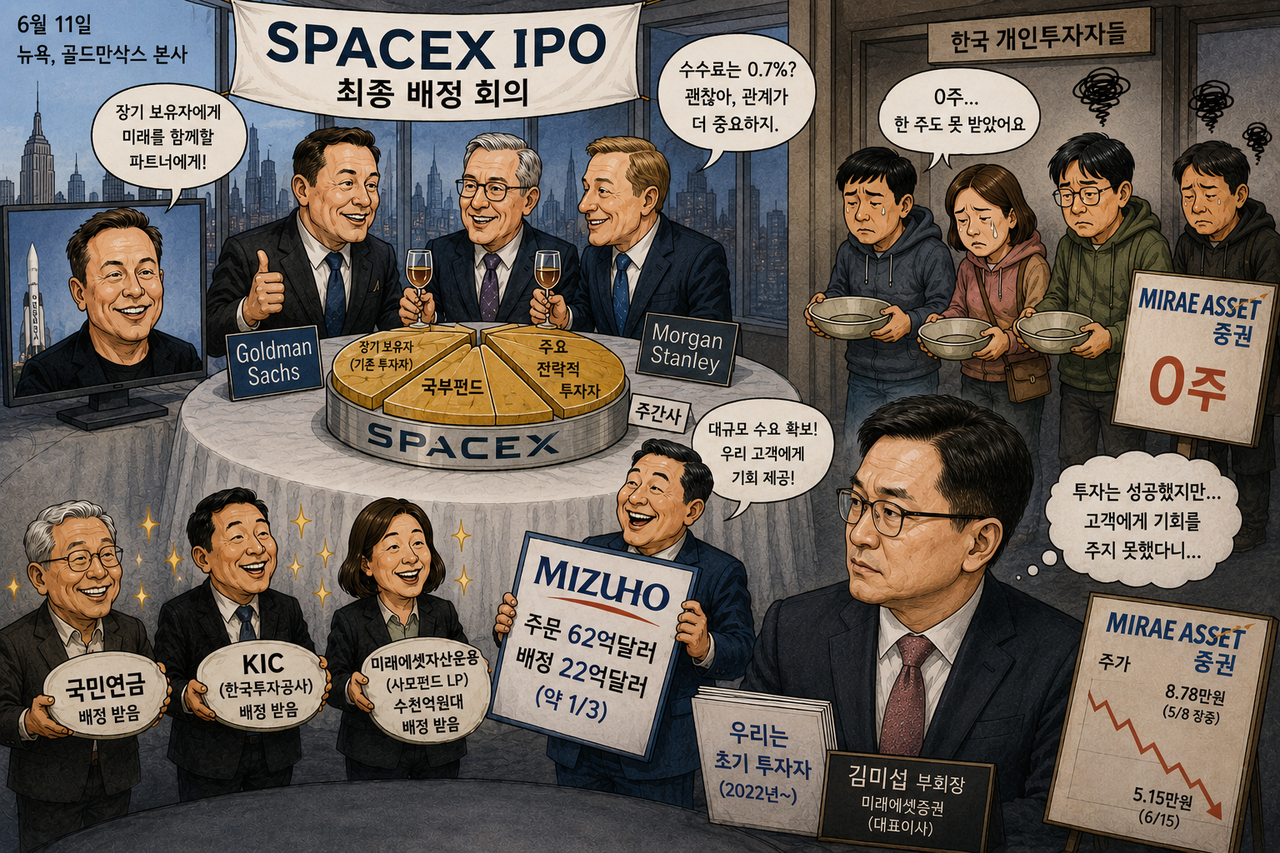
The scene was Goldman Sachs headquarters in New York on June 11.
SpaceX's underwriters and company officials were finalizing share allocations for the initial public offering. Elon Musk, SpaceX's CEO, watched the process via video link.
The IPO was unlike a typical public offering. According to foreign media reports, the underwriters did not simply look at the size of each order. They also weighed the likelihood of long-term holding, the probability of selling immediately after listing, and each investor's relationship with the SpaceX and Musk ecosystem.
A substantial portion of the offering went to long-term investment funds, sovereign wealth funds and existing major investors. Retail investors and hedge funds received limited allocations. One small hedge fund that applied for $80 million worth of shares reportedly received only about $20 million.
Goldman Sachs and the other underwriters reportedly asked investors to show how much cash they actually held in their accounts, rather than simply stating how many shares they wanted — a way of screening out those who were merely brokering orders or looking to flip shares quickly. The British Financial Times (FT) reported the details on June 11.
In South Korea, the national pension fund, the Korea Investment Corporation and Mirae Asset Global Investments received allocations as institutional investors. Mirae Asset Global Investments participated in the US IPO as a limited partner in a private equity fund designed specifically for the SpaceX offering, and secured hundreds of billions of won worth of shares.
Retail investors in South Korea who applied through Mirae Asset Securities, however, received not a single share. The firm gathered roughly $1 billion in retail subscriptions from about 700 applicants.
Japan's Mizuho Securities fared very differently. Mizuho assembled orders of roughly $6.2 billion and ultimately secured about $2.2 billion worth of shares — roughly one-third of what it applied for.
Industry observers say the core issue was not simply "Korea being passed over" but rather the difference in order size and investor quality. Although Mirae Asset Securities had expected some allocation given that it is an affiliate of Mirae Asset Group — an early SpaceX investor — analysts say the size and quality of its retail order book ultimately proved more decisive in the final allocation process.
Mirae Asset Securities collected roughly $1 billion in retail subscriptions from domestic investors, compared with Mizuho's roughly $6.2 billion — a gap of more than six times.
In IPO allocations, the order book is a critical yardstick. Underwriters evaluate not just the dollar amount of subscriptions but also the realistic ability to deploy capital, the number of investors involved, and the likelihood that shares will be held after listing.
Mizuho leveraged its US domestic network to build large-scale demand. Mirae Asset Securities, by contrast, faced constraints including domestic foreign-exchange market conditions, regulatory scrutiny and a focus on professional investors, all of which limited the overall size of its order book.
Mirae Asset Group is classified as an early SpaceX investor, having committed hundreds of billions of won at the group level since 2022. The listing has revalued its existing stake at several trillion won. But early-investor status did not guarantee retail IPO allocations.
The global investment banks that underwrote the SpaceX IPO reportedly accepted a fee rate of about 0.7 percent — well below the typical range of 1 to 3 percent. The strategic value of providing clients with access to the deal and maintaining relationships with Musk and SpaceX outweighed the fee income.
The market's verdict is showing up in Mirae Asset Securities' share price. The stock climbed to 87,800 won (about $58) during trading on May 8 before falling to 51,500 won on Monday — a decline of more than 40 percent in roughly two months. The share price had reflected not only the value of the firm's SpaceX stake but also expectations that it would emerge as South Korea's leading global investment bank. The zero-allocation episode suggests that while Mirae Asset Securities has delivered results as a SpaceX investor, its ability to reliably secure client allocations in major overseas IPOs remains an open question.
kyhong@heraldcorp.com