
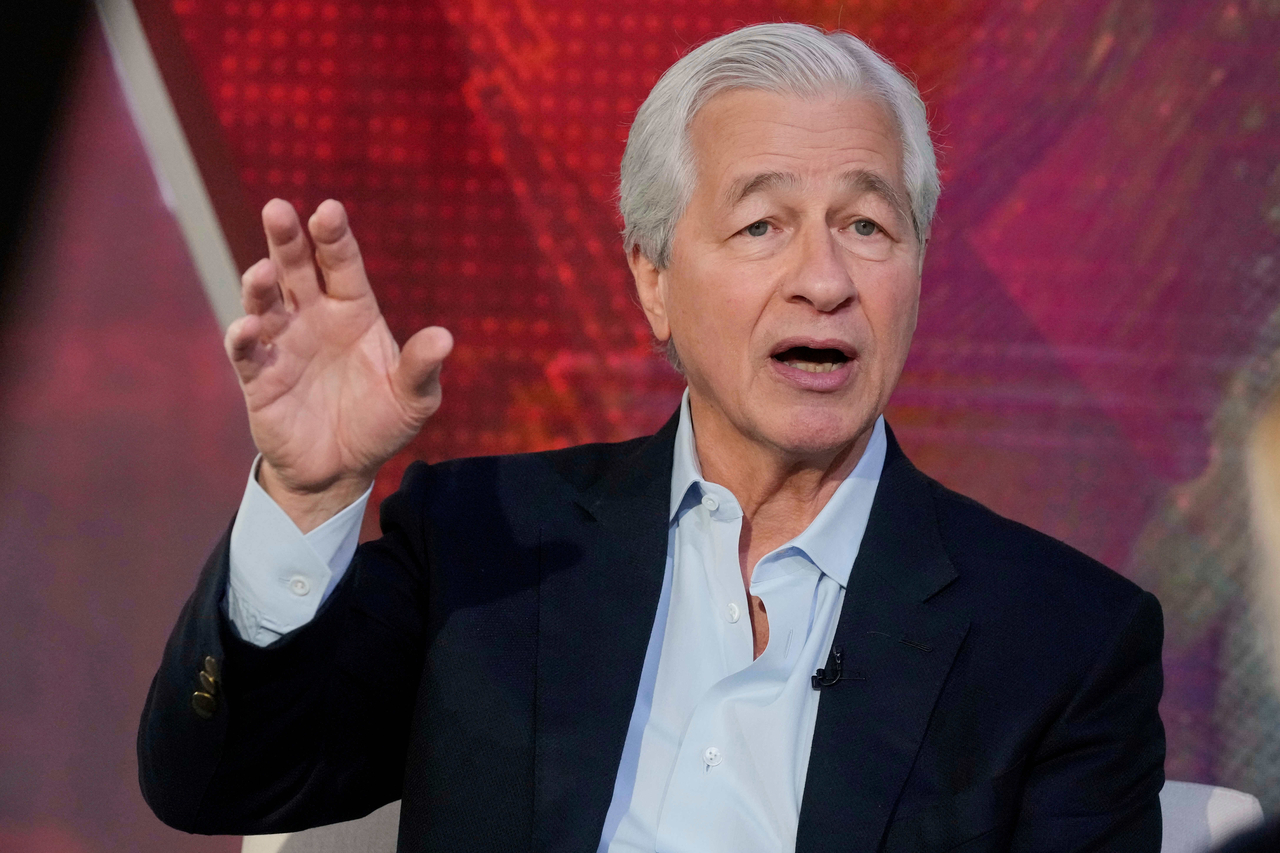
Jamie Dimon, CEO of JPMorgan Chase, warned Sunday that the risk of defaults in private credit markets targeting highly leveraged companies could prove more serious than anticipated.
In his annual shareholder letter, Dimon said a credit cycle will inevitably arrive. "I am convinced that when that time comes, losses across leveraged loans will exceed expectations given the economic environment," he said.
Leveraged loans refer to debt financing raised by companies that carry heavy debt loads or hold low credit ratings.
Dimon said lending standards have loosened across nearly every segment of the market, citing optimistic assumptions about future earnings, lax loan covenants and a growing use of payment-in-kind, or PIK, structures — a method in which interest is not paid in cash but instead added to the principal balance.
He also said private credit tends to lack transparency and rigorous underwriting standards. "This means that even if realized losses have not changed significantly, investors may be more likely to sell simply on fears that market conditions will deteriorate," he said.
Private credit broadly refers to lending extended by non-bank financial intermediaries rather than traditional banks.
As credit risk warnings mount around the private credit market, Wall Street investment firms with major private credit operations — including Blackstone, Ares, Apollo and Blue Owl — are facing a wave of redemption requests from customers seeking to withdraw their money.
Dimon said the private credit leveraged loan market stands at roughly $1.8 trillion, surpassing the entire US high-yield bond market of $1.5 trillion.
However, he said the market remains relatively small compared with the investment-grade bond market ($13 trillion) and the residential mortgage market ($13 trillion), and that private credit is therefore unlikely to pose a systemic risk in the broader context.
Dimon had previously sounded the alarm on credit market risks, including private credit, after the bankruptcies of US companies First Friends and Tricolor in October last year. "If you see one cockroach, there are probably more," he said at the time.
Meanwhile, on geopolitical risks including the ongoing US-Iran war and the Russia-Ukraine war, Dimon warned that "the potential impact of war on energy prices could trigger unpredictable consequences."
"Countries that are heavily dependent on energy imports are already feeling the effects," he said, adding that tangled global supply chains are causing disruptions across sectors including shipbuilding, food and agriculture.
He said the outcome of current geopolitical developments "could become a defining variable in how the global economic order unfolds going forward."
Dimon said a confluence of negative factors could tip the economy into recession, though the nature of any downturn could vary by region. He also raised the possibility of stagflation — a recession accompanied by rising inflation.
The real "skunk at the party," he said, could be inflation that fails to ease and instead creeps higher. He warned that this scenario, which he said could materialize this year, "could by itself cause interest rates to rise and asset prices to fall." A decline in asset prices, he added, could at some point sharply shift sentiment and trigger a large-scale flight to cash.
mokiya@heraldcorp.com




